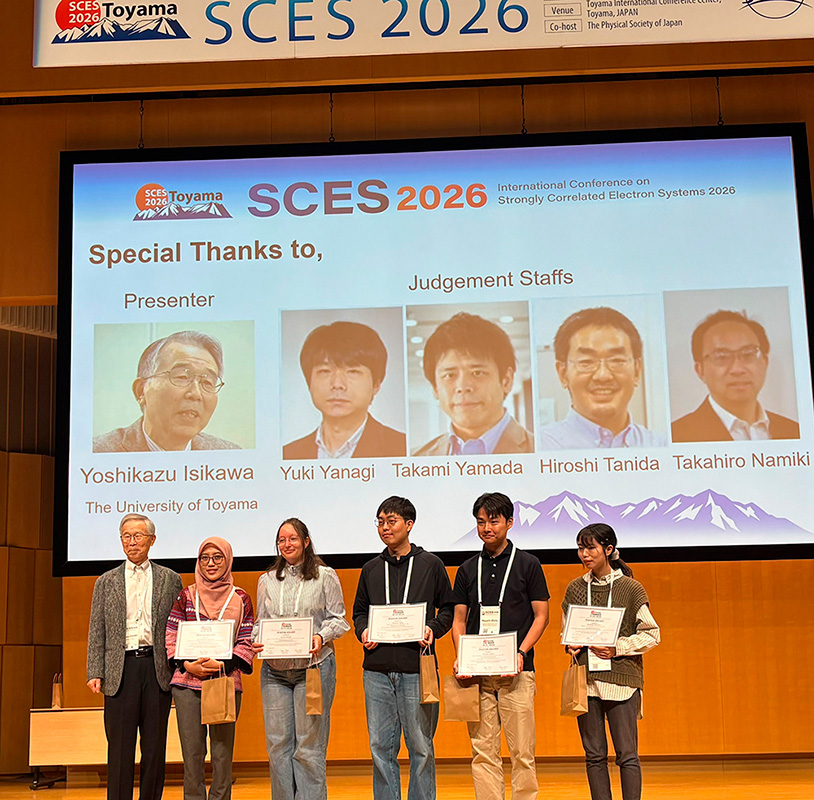
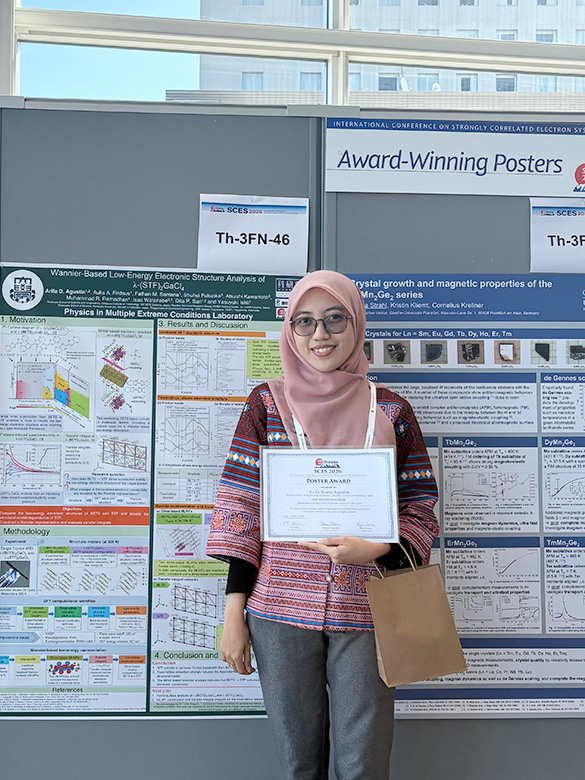
Arifa Diana AgustinさんがSCES 2026にてPoster Awardを受賞
2026/10/08
- 地域環境システム専攻
- SWiTCH
受賞者
Arifa Diana Agustinさん(地域環境システム専攻/Regional Environment Systems)
指導教員
石井 康之 教授(工学部)/Professor Yasuyuki Ishii
学会・大会名
International Conference on Strongly Correlated Electron Systems 2026 (SCES 2026)
賞名
Poster Award
発表題目
Wannier-Based Low-Energy Electronic Structure Analysis of λ-(STF)2GaCl4
研究内容
Organic molecular materials can exhibit a wide range of electronic behavior, from insulating states to superconductivity, depending on subtle changes in their molecular structure and composition. In this research, we studied the electronic structure of λ-(STF)₂GaCl₄ and compared it with the related superconductor λ-(BETS)₂GaCl₄ to understand how electrons behave and interact in these materials. Using calculations based on their crystal structures, we examined the electronic states that are most relevant to their physical properties and developed a theoretical representation of how electrons move between molecules. This approach allows us to investigate how changes in molecular composition and arrangement affect the pathways through which electrons move within the material. The calculations revealed differences in the electronic behavior of the two materials and also showed how the predicted properties of λ-(STF)₂GaCl₄ depend on its structural model. These findings provide a microscopic understanding of the electronic characteristics of λ-(STF)₂GaCl₄ and a theoretical basis for further studies of λ-type organic molecular materials.
研究目的
The purpose of this research is to understand how changes in molecular composition and structure affect the behavior of electrons in organic materials, and how these changes are related to unusual electronic properties such as insulating behavior and superconductivity.
今後の展望
研究目的
The purpose of this research is to understand how changes in molecular composition and structure affect the behavior of electrons in organic materials, and how these changes are related to unusual electronic properties such as insulating behavior and superconductivity.
今後の展望
Many aspects of unconventional superconductivity are still not fully understood. By improving our understanding of how molecular structure and electron behavior are connected, this research may help clarify the fundamental mechanisms behind superconductivity in organic materials. In the future, this knowledge may contribute to the design and discovery of new materials with desirable electronic properties. A deeper understanding of superconducting materials could ultimately support the development of energy-efficient technologies, quantum computing, and other next-generation applications.