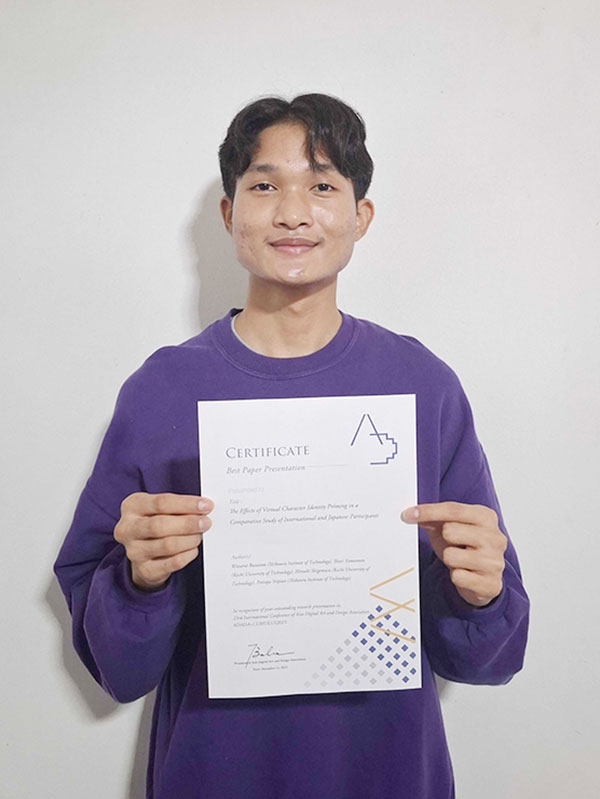
Witsarut Buaaiamさんが 23rd International Conference of Asia Digital Art and Design Association にて Best Paper Presentations を受賞
- その他
受賞者
Witsarut Buaaiamさん(Research Exchange Program学生:プログラム期間:9/24/2024 ~ 5/31/2025)
指導教員
Peeraya Sripian 准教授(工学部 先進国際課程/Innovative Global Program)
学会・大会名
賞名
The Effects of Virtual Character Identity Priming in a Comparative Study of International and Japanese Participants
外国人と日本人の比較における仮想キャラクターのアイデンティティ・プライミング効果
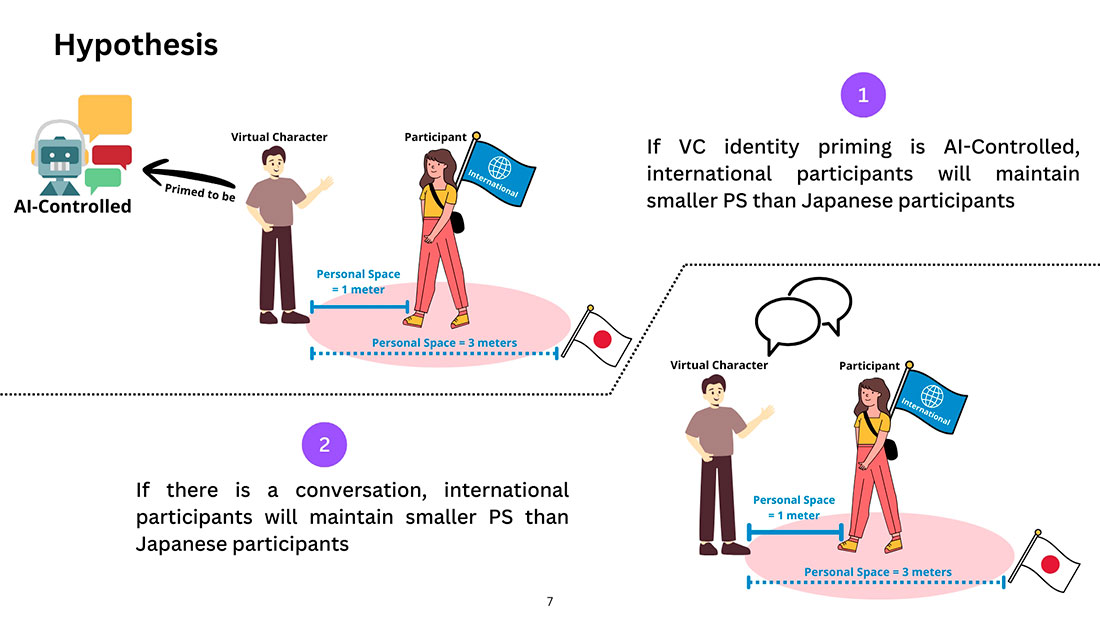
This study investigates how cultural backgrounds affect "personal space" (the comfortable distance between people) in VR. In a collaboration between Shibaura Institute of Technology and Kochi University of Technology (Prof. Hiroaki Shigemasu), we compared international residents in Japan with native Japanese participants. We examined how factors such as conversation and perceptions of a character as "Human" or "AI" influence social distance across cultures to help design more culturally sensitive AI.
本研究では、VR空間において「他人にどこまで近づかれると不快に感じるか(パーソナルスペース)」が、文化の違いによってどう変わるのかを調査しました。芝浦工業大学と高知工科大学(繁桝博昭教授)の共同研究として、日本在住の外国人と日本人の距離感を比較しました。会話の有無や、相手を「人間」か「AI」と認識する違いが、文化間でどう影響し合うかを探り、より適切なAI設計に繋げることを目的としています。
Our research aims to clarify the rules of "comfortable social distance" in VR by comparing data from international residents and Japanese participants. This goal stems from the growing need for system designs that respect diverse cultural backgrounds as human-AI interaction becomes more common. Specifically, we analyzed how factors such as engaging in conversation or perceiving a character as human versus AI influence personal space across different cultures.
本研究の目的は、日本在住の外国人と日本人のデータを比較することで、VR空間における「心地よい距離感」のルールを解明することです。背景には、人間とAIの交流が日常的になる中で、それぞれの文化に配慮したシステム設計が必要とされていることがあります。具体的には、「会話の有無」や「相手が人間かAIか」という認識の違いが、文化ごとにパーソナルスペース(対人距離)へどう影響を与えるかを詳しく分析しています。
今後の展望
As we move toward a future where humans and AI coexist in both physical and virtual worlds, this research provides the foundation for "culturally respectful" design. By clarifying how cultural backgrounds influence personal space, we offer practical insights for creating socially aware AI and localized VR services that understand local manners.
These findings allow us to treat personal space as a key setting for AI and robotic systems, enabling them to adjust their behavior to make users feel more comfortable. Ultimately, this work helps reduce cultural friction and promotes a world where people can collaborate effectively and ethically with AI on a global scale.
現実世界とバーチャル空間の両方で「人間とAIの共存」があたりまえになる中、本研究は、お互いの文化を尊重したコミュニケーション設計の土台となります。文化による「距離感」の違いをデータで示すことで、相手に合わせて振る舞いを変えられる「空気の読めるAI」や、地域ごとのマナーに配慮したVRサービスの実現が可能になります。
この知見をAIやロボットの制御システムに応用することで、使う人が「快適だ」と感じる距離を自動で保つ技術の開発が進みます。これにより、国や文化の壁を越えたスムーズな交流を助け、世界中の人々がストレスなくAIと協力し合える豊かな社会を目指します。