New Framework for Paper-Based Helical Origami Wearable Sensors to Conform to Body Shapes
- Research
A new parametric design framework transforms flat paper sheets into self-folding helical sensors that measure biosignals without straps or adhesives
Paper-based sensors offer a cheaper, more sustainable alternative to conventional polymer-based wearables, but designing customized devices for different body shapes remains challenging. Now, researchers have developed a paper-based wearable sensor platform that transforms flat sheets of paper into self-folding helical structures that conform to the body. By integrating copper tape electrodes, the device measures biosignals with performance comparable to conventional strap-based sensors. The approach enables low-cost fabrication of disposable wearables for sensing applications.
Title:Creating self-folding helical wearable sensors from flat paper sheets
Caption:Researchers develop a parametric design tool that converts the desired dimensions of a body part into a printable 2D pattern for a self-folding paper wearable device. This approach integrated with copper tape electrodes allows biosignal measurements.
Credit: Dr. Hiroki Shigemune from Shibaura Institute of Technology, Japan
Source Link:https://advanced.onlinelibrary.wiley.com/doi/10.1002/adsr.70182
License Type: CC BY 4.0
Usage restrictions: Credit must be given to the creator.
Wearable sensors, such as wristbands, rings, and adhesive patches, are becoming increasingly common for healthcare monitoring, fitness tracking, and human–machine interaction. While most wearable devices are made from flexible polymers or textiles, paper-based sensors are emerging as a cheaper and more sustainable alternatives. Such sensors could be used for applications such as medical diagnosis or detecting contaminants and toxins, and could be safely discarded after use.
Now, a team of researchers led by Associate Professor Hiroki Shigemune, College of Engineering, Shibaura Institute of Technology, Japan, along with Mr. Yugo Takashima, Shibaura Institute of Technology, Japan, have developed a parametric design tool that transforms flat sheets of paper into self-folding, helical wearable sensors. The new approach integrating copper tape electrodes allow sensors to automatically conform to the desired dimensions of a body part without straps or adhesives and can help measure biosignals. The study was made available online on July 25, 2026, and was published in Volume 5, Issue 7 of the journal Advanced Sensor Research on July 01, 2026.
“We were inspired by the way climbing vines naturally wrap around supports in a helical form and adapt to their shape. By combining this concept with our paper self-folding technology, we developed a parametric design tool that converts the desired dimensions of a body part, such as finger, wrist, or arm, into a printable 2D pattern to generate a customized self-folding paper wearable device,” says Dr. Shigemune.
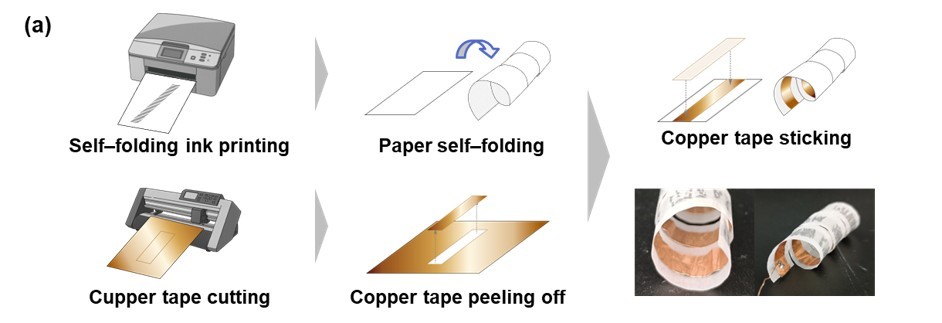
The fabrication process begins by printing self-folding patterns onto a flat sheet of paper using a standard inkjet printer. The printed patterns cause the paper to bend and fold automatically along predefined crease lines. By arranging these crease lines at an angle, the individual folds gradually form a 3D helical structure that conforms to the wearer’s body while remaining flexible enough to accommodate movement.
The researchers created two software tools to produce these wearables. One generates the printing pattern and previews the final 3D structure, while the other automatically creates a customized printing pattern based on the desired dimensions of the wearable. Users simply enter the desired dimensions—such as the diameter and length needed to fit a finger or forearm—and the software calculates the paper dimensions and generates the corresponding printing pattern.
Using this approach, the researchers successfully fabricated wearable devices for both fingers and forearms that closely matched their intended designs, with their dimensions differing within 5% from the target values. They then demonstrated the sensing capability using a finger-mounted device, which measured triboelectric signals and galvanic skin response with performance comparable to that of conventional strap-based wearable sensors.
These findings demonstrate that paper, digital design, and inkjet printing can be combined to rapidly produce customized wearable sensors on demand. By combining sustainable materials with a simple software-guided design process, the approach could enable low-cost, disposable wearable electronics. The researchers note that further testing is needed to evaluate the sensor’s practical use. However, the results demonstrate the potential of this approach for developing scalable and personalized wearable electronics.
“Our software-to-print approach holds great potential in point-of-care or decentralized short-term monitoring of physiological signals, such as galvanic skin response. Because the devices can be designed on demand to fit different body parts, the approach could enable rapid, low-cost, environmentally friendly fabrication of single-use sensors for clinical, homecare, and field settings, as well as for touch sensing and human–machine interfaces,” concludes Dr. Shigemune.
Wearable sensors, such as wristbands, rings, and adhesive patches, are becoming increasingly common for healthcare monitoring, fitness tracking, and human–machine interaction. While most wearable devices are made from flexible polymers or textiles, paper-based sensors are emerging as a cheaper and more sustainable alternatives. Such sensors could be used for applications such as medical diagnosis or detecting contaminants and toxins, and could be safely discarded after use.
Now, a team of researchers led by Associate Professor Hiroki Shigemune, College of Engineering, Shibaura Institute of Technology, Japan, along with Mr. Yugo Takashima, Shibaura Institute of Technology, Japan, have developed a parametric design tool that transforms flat sheets of paper into self-folding, helical wearable sensors. The new approach integrating copper tape electrodes allow sensors to automatically conform to the desired dimensions of a body part without straps or adhesives and can help measure biosignals. The study was made available online on July 25, 2026, and was published in Volume 5, Issue 7 of the journal Advanced Sensor Research on July 01, 2026.
“We were inspired by the way climbing vines naturally wrap around supports in a helical form and adapt to their shape. By combining this concept with our paper self-folding technology, we developed a parametric design tool that converts the desired dimensions of a body part, such as finger, wrist, or arm, into a printable 2D pattern to generate a customized self-folding paper wearable device,” says Dr. Shigemune.
The fabrication process begins by printing self-folding patterns onto a flat sheet of paper using a standard inkjet printer. The printed patterns cause the paper to bend and fold automatically along predefined crease lines. By arranging these crease lines at an angle, the individual folds gradually form a 3D helical structure that conforms to the wearer’s body while remaining flexible enough to accommodate movement.
The researchers created two software tools to produce these wearables. One generates the printing pattern and previews the final 3D structure, while the other automatically creates a customized printing pattern based on the desired dimensions of the wearable. Users simply enter the desired dimensions—such as the diameter and length needed to fit a finger or forearm—and the software calculates the paper dimensions and generates the corresponding printing pattern.
Using this approach, the researchers successfully fabricated wearable devices for both fingers and forearms that closely matched their intended designs, with their dimensions differing within 5% from the target values. They then demonstrated the sensing capability using a finger-mounted device, which measured triboelectric signals and galvanic skin response with performance comparable to that of conventional strap-based wearable sensors.
These findings demonstrate that paper, digital design, and inkjet printing can be combined to rapidly produce customized wearable sensors on demand. By combining sustainable materials with a simple software-guided design process, the approach could enable low-cost, disposable wearable electronics. The researchers note that further testing is needed to evaluate the sensor’s practical use. However, the results demonstrate the potential of this approach for developing scalable and personalized wearable electronics.
“Our software-to-print approach holds great potential in point-of-care or decentralized short-term monitoring of physiological signals, such as galvanic skin response. Because the devices can be designed on demand to fit different body parts, the approach could enable rapid, low-cost, environmentally friendly fabrication of single-use sensors for clinical, homecare, and field settings, as well as for touch sensing and human–machine interfaces,” concludes Dr. Shigemune.

Title: Parametric design software for self-folding helical paper wearable sensors
Caption: The software-to-print approach allows users to provide the desired dimensions of the wearable device, which automatically creates the paper design and printing pattern needed for fabrication, enabling rapid customization without trial and error. This approach could contribute to scalable and personalized wearable electronics, particularly for disposable or sensing applications
Credit: Dr. Hiroki Shigemune from Shibaura Institute of Technology, Japan
Source Link: https://advanced.onlinelibrary.wiley.com/doi/10.1002/adsr.70182
License Type: CC BY 4.0
Usage restrictions: Credit must be given to the creator.
Reference
|
Title of original paper: |
Design Software for Helical Origami Wearable Devices Fitting Body Shapes Utilizing Parametric Design |
|
Journal |
Advanced Sensor Research |
|
DOI: |
Authors
About Dr. Hiroki Shigemune from SIT, Japan
Dr. Hiroki Shigemune is an Associate Professor at the College of Engineering, Shibaura Institute of Technology (SIT), Japan. He earned his Doctorate in Mechanical Engineering from Waseda University, Japan, in 2018, and has over 90 peer-reviewed publications to date. His research mainly focuses on soft robotics, paper-based mechatronics, and smart materials. His work explores technologies including energy-driven actuators, electronic devices, and innovative sensing platforms designed to enhance everyday life.
Funding Information
This study was supported by JSPS KAKENHI Grant Number JP22K14226 and JP24H00728.