Rain Gardens Offer a Balanced Solution for Managing Urban Stormwater Near Tokyo
- Research
Researchers compared Rain Barrels, Rain Gardens, and their combination to assess flood control, costs, and environmental benefits in residential areas
Urban flooding is an increasing challenge in densely built-up residential areas. Researchers from Shibaura Institute of Technology, Japan, integrated hydrological modeling, life-cycle cost assessment, ecosystem-service valuation, and multi-criteria analysis to compare Rain Barrels and Rain Gardens (RG) near Tokyo. RG achieved the highest comprehensive scores across three residential catchments, while combining both measures offered competitive flood-control benefits. The findings provide a quantitative framework for selecting stormwater management strategies according to local conditions and planning priorities.
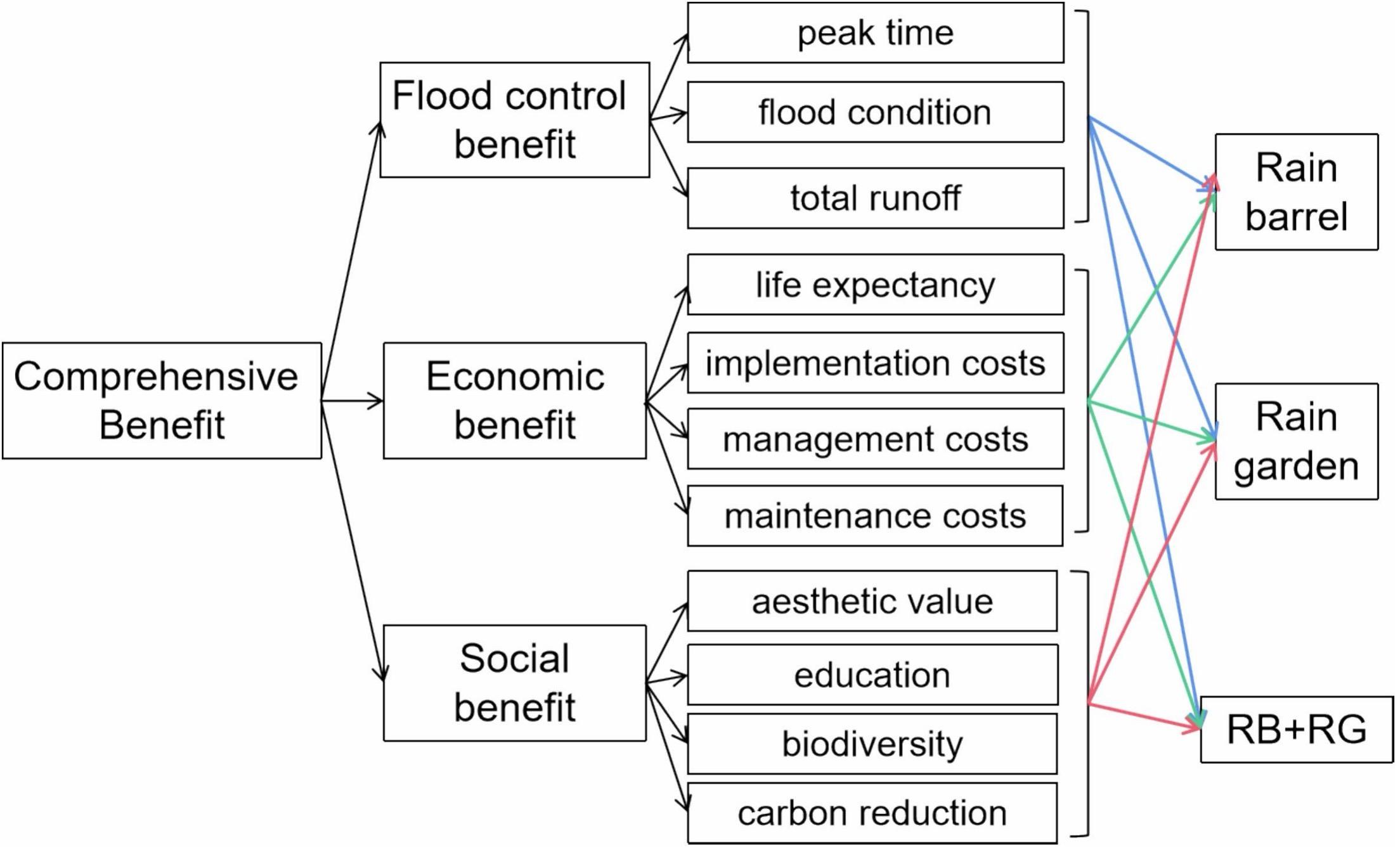
Title: Hierarchy of Criteria for Evaluating Residential Stormwater Solutions
Caption: Researchers from SIT Japan developed a hierarchical assessment framework comparing Rain Barrels, Rain Gardens, and their combined implementation across flood-control, economic, and social criteria to support stormwater management decisions in residential areas.
Credit: Ms. Jiajing Lin from SIT, Japan
Source Link: https://doi.org/10.1016/j.cacint.2026.100480
License Type: CC BY 4.0
Usage restrictions: Credit must be given to the creator.
Urban flooding is becoming a growing concern in densely developed neighborhoods, where paved surfaces limit infiltration and intense rainfall can overwhelm drainage systems. Low Impact Development measures, such as Rain Barrels (RB) and Rain Gardens (RG), help manage stormwater close to where it falls. RB collect rooftop runoff for later non-potable use, while RG use vegetated depressions and soil to encourage infiltration. Although both approaches can reduce runoff, their performance and costs vary with local conditions. Studies often assess flood control, costs, and environmental benefits separately, complicating comparisons.
Addressing this challenge, a research team led by doctoral student Jiajing Lin from the Regional Environment Systems, Graduate School of Engineering and Science, Shibaura Institute of Technology (SIT), Japan, along with Mr. Hiroyuki Taguchi and Professor Hitoshi Nakamura from the College of Systems Engineering and Science at SIT, developed an integrated framework to compare RB, RG, and their combined implementation (RB + RG) in three flood-prone residential catchments in Saitama City near Tokyo: Miyahara, Higashimiyashita, and Motobuto. The team combined the U.S. Environmental Protection Agency’s Storm Water Management Model with life-cycle cost assessment, the Benefit Estimation Tool (B£ST), and the Analytic Hierarchy Process (AHP). Seven experts weighted criteria including runoff reduction, costs, service life, and ecosystem benefits. Their findings were made available online on September 24, 2026, and will be published in Volume 32 of the journal City and Environment Interactions on December 1, 2026.
The simulations showed that the most effective measure depended partly on the catchment. In Miyahara, RG reduced peak runoff by 35.78% and delayed the peak by 20 minutes. The combined approach delivered the largest total runoff reduction there, at 30%. In Higashimiyashita, the combined scenario reduced peak runoff by 3.46%, cut total runoff volume by 10.89%, and delayed the peak by 20 minutes. In Motobuto, it reduced peak runoff by 7.95% and total runoff volume by 8.95%, with a 10-minute peak delay. Across sites, combined measures generally reduced total runoff the most.
“RG can offer more than runoff control because their vegetation also supports neighborhood amenity and other ecosystem services,” said Ms. Lin.
B£ST assessed aesthetic, educational, biodiversity, and carbon benefits. The combined scenario generally produced the highest social and environmental scores, while RB alone had more limited ecosystem-service benefits. However, the economic assessment favored RG, whose comprehensive economic scores ranged from 0.401–0.427, compared with 0.375–0.406 for RB. Installing both measures increased costs and resulted in the lowest economic scores for the combined scenario.
When flood-control, economic, and social criteria were considered together, RG achieved the highest comprehensive scores in all three catchments: 0.416 in Miyahara, 0.400 in Higashimiyashita, and 0.395 in Motobuto. RB alone ranked lowest overall. The combined approach remained competitive where runoff-volume reduction was a priority.
“There is no single solution that will suit every neighborhood; the preferred measure depends on local hydrology, available space, costs, and planning goals,” said Ms. Lin.
Overall, the study offers urban planners a transparent way to compare decentralized stormwater measures using hydrological, economic, and ecosystem-service indicators within one decision-making framework. The authors caution that the analysis used one design rainfall event, relied on expert-selected AHP weights and assumptions to adapt B£ST to Japan, and covered only three catchments. Further studies should test multiple storms, sensitivity, and additional locations.
Reference
|
Title of original paper: |
Comprehensive evaluation of the role of rain barrels and rain gardens in densely built-up residential areas near Tokyo |
|
Journal: |
City and Environment Interactions |
|
DOI: |
Additional infotmation for EurekAlert
| Latest Article Publication Date: |
1 December 2026 |
| Method of Research: |
Computational simulation/modeling |
| Subject of Research: |
Not Applicable |
| Conflicts of Interest Statement: |
The authors declare that they have no known competing financial interests or personal relationships that could have appeared to influence the work reported in this paper. |
Authors
About Ms. Jiajing Lin from SIT, Japan
Ms. Jiajing Lin is a doctoral researcher in the Regional Environment Systems Course at the Graduate School of Engineering and Science, Shibaura Institute of Technology, Japan. Operating within the Laboratory of Planning for Urban and Regional Resilience under Professor Hitoshi Nakamura, her work targets climate change adaptation and urban pluvial flood mitigation using nature-based solutions and IoT integrations. Specifically, she focuses on green infrastructure by enhancing the combined efficacy of Rain Gardens and Rain Barrels. She also develops smart stormwater management simulating how smart rain barrels integrated with automated pumps and weather forecasts proactively drain before storms to prevent urban sewer overloads.
Funding Information
This study was not supported by any specific grant from funding agencies.