AI Reveals How Coating Thickness Changes the Link Between Surface Roughness and Pitting Resistance
- Research
Researchers at Shibaura Institute of Technology identify a thickness-dependent interaction in steam-grown protective films on aluminum alloy
Pitting corrosion can threaten the durability of aluminum components. Researchers from Shibaura Institute of Technology, Japan, used interpretable machine learning to reveal a critical shift in how surface morphology affects steam-coated aluminum. The model identified a thickness-dependent change in this interaction near 2,200 nm, or 2.2 µm, within a specific roughness range. The findings suggest directions for coating design and further experimental validation.
Localized pitting corrosion can cause sudden failure in aluminum components even when overall corrosion rates are low. Steam coating offers a water-vapor-based route to protective boehmite films, but processing simultaneously changes film thickness, surface morphology, crystallinity, and substrate defects. These intertwined changes make it difficult to determine which physical features govern corrosion resistance and how coatings should be optimized.
Addressing this challenge, a research team led by Professor Takahiro Ishizaki and Master's student Kei Masuhara from Shibaura Institute of Technology (SIT), Japan, used an interpretable machine-learning framework to examine 90 steam-coated A6061-T6 aluminum specimens. Four descriptors—film thickness (FT), surface morphology (SQ), crystallite size (CS), and substrate dislocation density index—were analyzed using Random Forest, Shapley Additive Explanations, and Accumulated Local Effects. Their findings were published online in the journal npj Materials Degradation on August 18, 2026.
The researchers assessed pitting resistance by measuring the pitting potential—the voltage at which localized corrosion begins—in a 5 wt.% sodium chloride solution at room temperature. Higher values indicate greater resistance to pitting under these test conditions. Surface morphology was quantified as the root-mean-square surface height, a measure of surface roughness denoted as SQ.
“We wanted to understand which features of the coating most strongly affect its ability to prevent pitting corrosion,” says Prof. Ishizaki. “Our analysis showed that the importance of these features changes as the coating grows.” The machine-learning model predicted corrosion resistance more accurately than a model based only on coating temperature and treatment time.
The analysis identified surface roughness and film thickness as the leading descriptors in the model. For specimens with SQ values of approximately 600–1,080 nm, the modeled interaction between roughness and thickness changed from positive to negative near a film thickness of 2,200 nm. This reversal concerns the interaction between the two descriptors, rather than the overall corrosion resistance of every coating above or below that thickness. The same reversal was not observed in the lower-roughness range.
The researchers interpret this pattern as a possible change in what surface roughness represents during film growth. In thinner coatings, roughness may reflect the development of protective coverage. In thicker coatings, it may instead be associated with structural irregularities that provide pathways for corrosive species. These interpretations remain hypotheses requiring further experimental testing. The analysis also identified a region-dependent interaction between surface roughness and CS, suggesting that their combination matters more than a simple “larger is better” rule.
These findings suggest directions for optimizing water-vapor-based protective coatings on lightweight aluminum alloys. Considering film thickness and surface roughness together could help guide future coating development. The descriptors were obtained using X-ray diffraction, confocal laser scanning microscopy, and cross-sectional electron microscopy. With further validation, such measurements could support data-driven coating assessment and quality control.
“The key insight is that higher roughness should not automatically be considered beneficial or harmful,” says Prof. Ishizaki. “Its meaning depends on the film-growth regime. Our model suggests a change near 2,200 nm within the higher-roughness range examined. This shows why coating design needs to consider how physical features interact.” A Monte Carlo analysis estimated that uncertainty in descriptor measurements contributed approximately 0.080 V to prediction variability, compared with an overall model RMSE of 0.292 V. This suggests that measurement uncertainty alone cannot explain the remaining prediction error.
Overall, the study demonstrates how interpretable machine learning can reveal physically meaningful regime changes in complex coating systems rather than simply predicting corrosion behavior. The identified SQ–FT transition and other region-dependent interactions provide model-supported hypotheses for future experimental validation, and may offer a transferable strategy for other interface-controlled materials, including environmental barrier coatings and battery interphases.
Reference
|
Title of original paper: |
Interpretable machine learning reveals a morphological regime shift governing pitting resistance in steam-coated boehmite films |
|
Journal: |
npj Materials Degradation |
|
DOI: |
10.1038/s41529-026-00862-0 |
Additional information for EurekAlert
|
Latest Article Publication Date: |
18 August 2026 |
|
Method of Research: |
Computational simulation/modeling |
|
Subject of Research: Animals |
Not applicable |
|
Conflicts of Interest Statement: |
The authors declare no competing interests. |
Authors
About Shibaura Institute of Technology (SIT), Japan
Shibaura Institute of Technology (SIT) is a private university with campuses in Tokyo and Saitama. Since the establishment of its predecessor, Tokyo Higher School of Industry and Commerce, in 1927, it has maintained “learning through practice” as its philosophy in the education of engineers. SIT was the only private science and engineering university selected for the Top Global University Project sponsored by the Ministry of Education, Culture, Sports, Science and Technology and had received support from the ministry for 10 years starting from the 2014 academic year. Its motto, “Nurturing engineers who learn from society and contribute to society,” reflects its mission of fostering scientists and engineers who can contribute to the sustainable growth of the world by exposing their over 9,500 students to culturally diverse environments, where they learn to cope, collaborate, and relate with fellow students from around the world.
Website: https://www.shibaura-it.ac.jp/en/
About Professor Takahiro Ishizaki from SIT, Japan
Prof. Takahiro Ishizaki is a Professor in the Department of Materials Science and Engineering, College of Engineering, Shibaura Institute of Technology, Japan. He received his Ph.D. from Waseda University in 2004, and has more than 20 years of experience in materials science and engineering research. His research interests include surface chemistry, electrochemistry, surface engineering, corrosion, coating technology, nanomaterials, and the synthesis and characterization of functional materials. He has authored 171 publications, which have received more than 4,700 citations, with an h-index of 36. His current research includes carbon synthesis for Li–air batteries and the development of functional energy materials.
Funding Information
This research was supported by the Adaptable and Seamless Technology Transfer Program through Target-driven R&D (A-STEP) from Japan Science and Technology Agency (JST) Grant Number JPMJTR23RJ.
Media Contact: Kohei Tsuchiya
E-mail: koho@ow.shibaura-it.ac.jp
Web: https://www.shibaura-it.ac.jp/en/
image
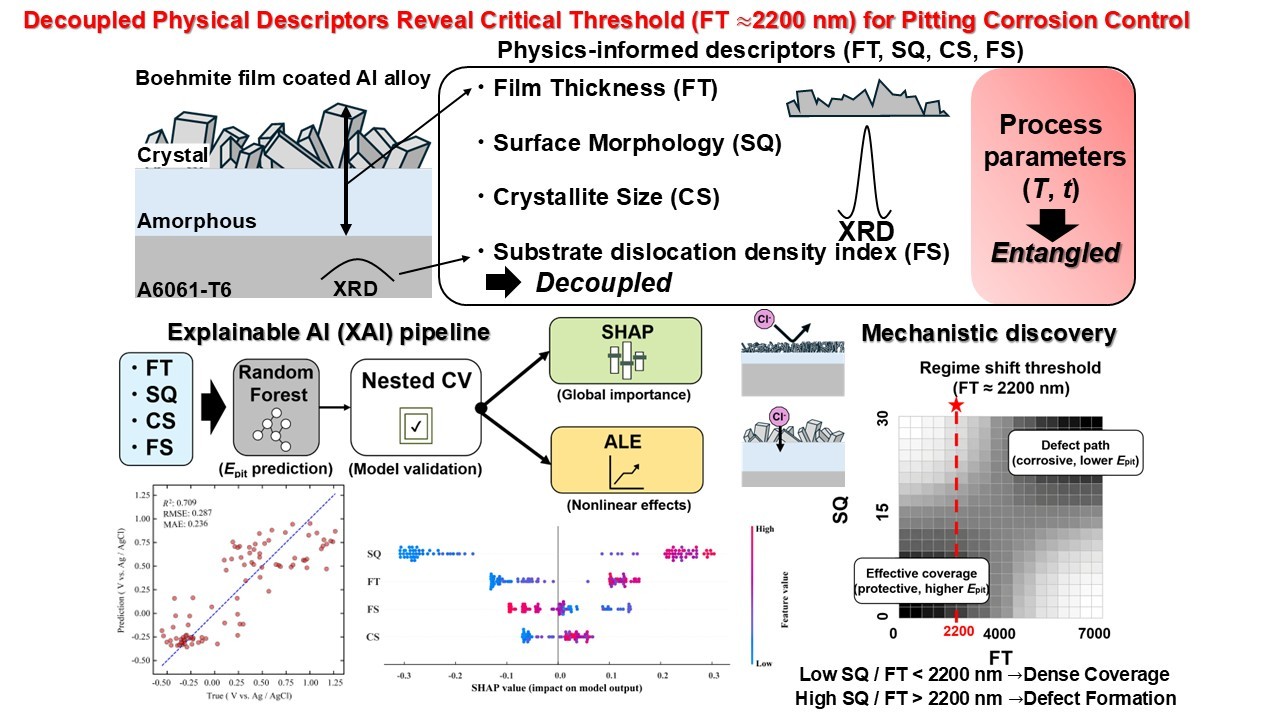
Caption:Decoupling of physics-informed descriptors revealing a model-supported transition near FT ≈ 2,200 nm in the higher-morphology regime.