Molecular Simulations Reveal How an Enzyme’s Shape Guides Molecular Recognition
- Research
Researchers from Shibaura Institute of Technology show that enzyme shape influences ligand retention and compound-specific sugar preference
Pyrimidine-nucleoside phosphorylase adopts different conformations that influence how it interacts with molecules. Researchers from Shibaura Institute of Technology, Japan, used molecular dynamics simulations to show that closed conformations retain ligands more strongly than open ones and that sugar preference varies by compound and conformation, highlighting enzyme flexibility as an important consideration for drug design, artificial nucleoside synthesis, and greener biocatalytic manufacturing, and provide a framework for future enzyme engineering and inhibitor-design studies.
Enzymes are often described as molecular machines that recognize and process specific molecules. However, they are not rigid structures. Their shapes can change, and these changes can affect how molecules enter, interact with, and remain within their active sites.
Pyrimidine-nucleoside phosphorylase (PyNP) is an enzyme involved in the production of nucleic-acid building blocks. It is relevant to the design of anticancer, antiviral, and antibacterial drugs and can also be used to synthesize artificial nucleosides. However, the molecular basis of how its changing shape affects molecular recognition has remained unclear.
Addressing this challenge, a research team led by Professor Akihiko Hatano, along with researcher Kousei Takeshima from the Course of Chemistry and Biotechnology, Department of Materials Science and Chemistry, College of Engineering, Shibaura Institute of Technology, Japan, investigated how different shapes of PyNP from Bacillus subtilis influence ligand retention and sugar preference. The team used all-atom molecular dynamics simulations across four conformational states, 13 structural probes, and molecular dynamics trajectories totaling 15.6 microseconds of simulation time. Their findings were published online in the journal ACS Omega on September 12, 2026.
For many years, the researchers have used this enzyme to synthesize artificial nucleosides and asked why changing the sugar can alter the reaction. “We wanted to understand this question from the perspective of atomic-scale motions that experiments alone cannot reveal,” said Prof. Hatano. “This led us to examine how the enzyme and its bound molecules behave across different structural states.”
The researchers first examined how the enzyme’s active-site pocket changes as the protein moves between different conformations. They found that the pocket expanded by approximately 1.4-fold between the most closed and most open states.
The simulations then revealed a relationship between enzyme shape and ligand retention. Across the simulations, 75.6% of trajectories in the closed group retained ligands in a bound state, compared with 55.1% in the open group, indicating that enzyme shape influences ligand retention.
The researchers also found that ribose- and 2′-deoxyribose-containing compounds did not show a universal preference. Instead, sugar preference depended on both the individual compound and the enzyme’s conformation. The researchers also observed distinct sugar-ring conformations: ribose occupied the North (C3′-endo) conformation for 64.3% of the sampled time, whereas 2′-deoxyribose occupied the South (C2′-endo) conformation for 57.9%. This difference was strongest for the unsubstituted compound and became smaller as the 6-position substituent grew larger.
A residue called Tyr165 emerged as a moving “lid” over the active site, particularly in the closed reference structure. Removing this residue in additional simulations reduced ligand retention, supporting the proposed lid mechanism at the computational level. However, the strongest Tyr165 signal came mainly from a closed structure belonging to a related species, so confirmation using a closed-state structure from B. subtilis is still needed.
The findings could have broader value for pharmaceutical and biotechnological research. PyNP is also used to synthesize fluorescently labeled nucleosides and stable-isotope-labeled nucleic acids. Understanding how enzyme shape affects molecular capture could help researchers design inhibitors and efficient enzymatic synthesis routes, while supporting greener manufacturing.
“Enzymes should not be viewed as single, static structures when we think about molecular recognition,” said Prof. Hatano. “Our results show that different conformations can change how compounds are retained and how sugar-related preferences emerge.” The study points to future calculations and experiments to determine how these interactions relate to the chemical steps.
Overall, the study demonstrates how examining multiple enzyme conformations with molecular simulations can reveal binding behavior that a single static structure may miss. By showing that ligand retention and sugar preference depend on molecular identity and enzyme shape, the work provides a framework for dynamic substrate recognition and future enzyme engineering, inhibitor design, and sustainable biocatalytic synthesis.
Reference
|
Title of original paper: |
Conformation- and Compound-Dependence of Ribose/2′-Deoxyribose Retention Patterns in Pyrimidine-Nucleoside Phosphorylase from Bacillus subtilis: A Four-Structure Molecular Dynamics Study |
|
Journal: |
ACS Omega |
|
DOI: |
10.1021/acsomega.6c08499 |
Additional information for EurekAlert
|
Latest Article Publication Date: |
12 September 2026 |
|
Method of Research: |
Computational simulation/modeling |
|
Subject of Research: Animals |
Not Applicable |
|
Conflicts of Interest Statement: |
The authors declare no competing financial interest. |
Authors
About Shibaura Institute of Technology (SIT), Japan
Shibaura Institute of Technology (SIT) is a private university with campuses in Tokyo and Saitama. Since the establishment of its predecessor, Tokyo Higher School of Industry and Commerce, in 1927, it has maintained “learning through practice” as its philosophy in the education of engineers. SIT was the only private science and engineering university selected for the Top Global University Project sponsored by the Ministry of Education, Culture, Sports, Science and Technology and had received support from the ministry for 10 years starting from the 2014 academic year. Its motto, “Nurturing engineers who learn from society and contribute to society,” reflects its mission of fostering scientists and engineers who can contribute to the sustainable growth of the world by exposing their over 9,500 students to culturally diverse environments, where they learn to cope, collaborate, and relate with fellow students from around the world.
Website: https://www.shibaura-it.ac.jp/en/
About Professor Akihiko Hatano from SIT, Japan
Prof. Akihiko Hatano is a Professor at the Course of Chemistry and Biotechnology, Department of Materials Science and Chemistry, College of Engineering, Shibaura Institute of Technology, Japan. Working within materials science, chemistry, and regional environmental systems, his research focus spans analytical and applied chemistry, including advanced chip sensors for chemical detection. With deep skills and expertise in specialized fields like thiols, his impactful academic contributions include 37 publications and 537 citations. He consistently drives sustainable engineering and green technology by understanding molecular-level mechanisms, advancing biochemical synthesis, and developing innovative green manufacturing applications for modern diagnostics and industries.
Funding Information
This work was supported by a Grant-in-Aid for Scientific Research (KAKENHI) from the Japan Society for the Promotion of Science (JSPS), Grant Number JP21K05315.
Media Contact: Kohei Tsuchiya
E-mail: koho@ow.shibaura-it.ac.jp
Web: https://www.shibaura-it.ac.jp/en/
image
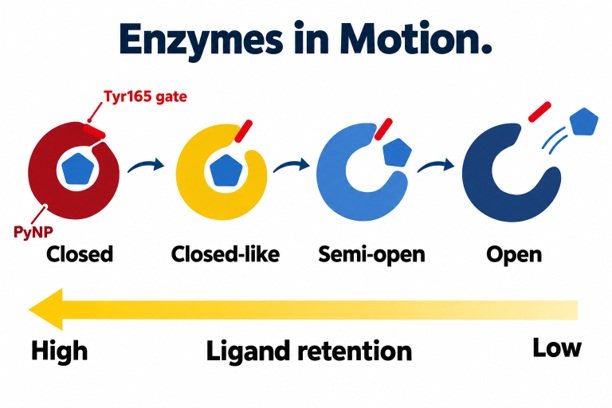
Caption: Molecular dynamics simulations of pyrimidine-nucleoside phosphorylase from Bacillus subtilis compare four conformational states, showing how changes in the enzyme’s active-site shape influence ligand retention and molecular recognition.