Stress-Assisted Conductivity Retention in High-Iodine LiBH₄ Thin Films
- Research
Researchers develop a multilayer method that enables high-iodine LiBH₄ thin films while improving room-temperature ionic conductivity
Solid electrolytes are promising materials for safer, more compact all-solid-state batteries, but producing smooth thin films with high ionic conductivity remains challenging. In a recent study, researchers from Shibaura Institute of Technology, Japan, developed a multilayer method using lithium borohydride and lithium iodide to create high-iodine thin films. Their approach improved iodine incorporation, maintained relatively smooth surfaces, and produced good room-temperature ionic conductivity, opening new possibilities for thin-film solid electrolytes.
All-solid-state lithium batteries require solid materials that allow lithium ions to move efficiently. Lithium borohydride (LiBH₄) is a promising material for this purpose because its high-temperature hexagonal phase supports rapid lithium-ion transport. Introducing iodide into LiBH₄ can stabilize this conductive phase at lower temperatures, but producing smooth films with enough iodine has been difficult. Earlier methods added only about 8% iodine and often produced rough surfaces, limiting their usefulness in thin-film devices.
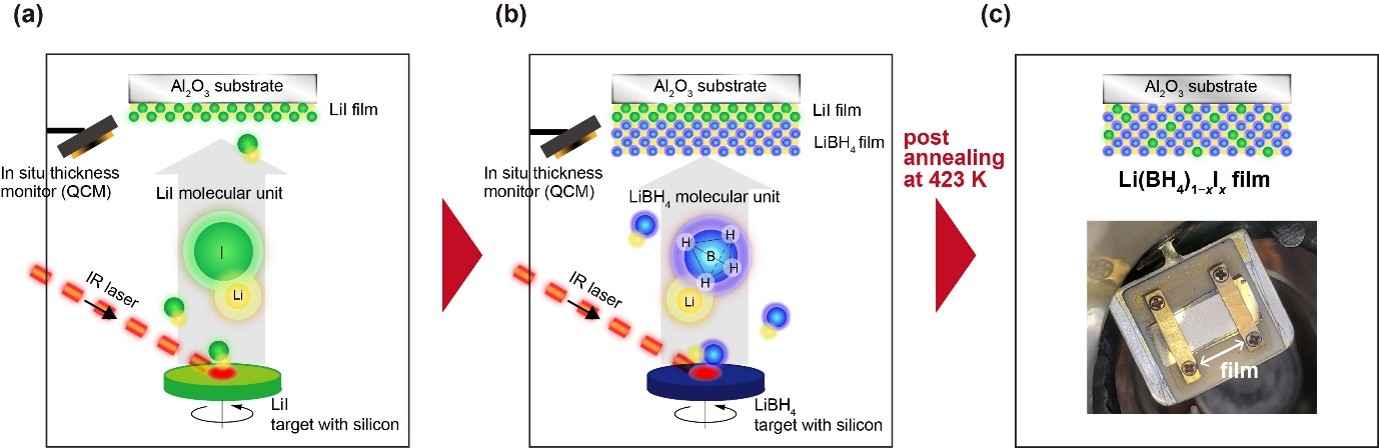
To address this challenge, a research team led by Ph.D. student Erika Fukushi and Professor Hiroyuki Oguchi from Shibaura Institute of Technology in Tokyo, Japan, developed a multilayer method. They deposited thin layers of lithium iodide and LiBH₄ one after another at room temperature, then heated them so the layers could mix through interdiffusion. This approach allowed the researchers to add more iodine while keeping the films relatively smooth. Their findings were made available online on May 27, 2026, and were published in Volume 11, Issue 22 of the journal ACS Omega on June 09, 2026.
“By depositing LiBH₄ and lithium iodide separately, we can overcome the different vapor pressures that previously limited iodine incorporation,” says Ms. Fukushi. “The multilayer design also lets us control composition through individual layer thicknesses while keeping deposition at room temperature, which helps suppress island-like growth seen in films deposited at higher temperatures.”
After heating, the separate layers had largely mixed together, with SEM/EDS indicating extensive interdiffusion and large-area compositional homogeneity, although some local iodine-rich regions remained. The new films contained iodide substitution levels of 20–40% (x = 0.20–0.40), a substantial increase from the previous limit of about 8%. They also remained relatively flat compared with films made using higher-temperature methods, which often developed uneven, island-like surfaces. This combination of composition control and surface smoothness could facilitate systematic studies of electrode/solid-electrolyte interfaces.
The films exhibited enhanced lithium-ion conductivity, with the best room-temperature conductivity reaching 4.9 × 10⁻⁵ S cm⁻¹. This value is comparable to or higher than that of widely used thin-film solid electrolytes such as LiPON. However, adding too much iodine reduced conductivity, suggesting that there is an optimal iodine level. At excessive concentrations, iodide can obstruct lithium-ion migration pathways through site blocking and iodine-induced lattice strain or expansion.
The researchers also found that some films continued to exhibit high ionic conductivity as they cooled after heating. This behavior gradually weakened over about one week, suggesting that the films temporarily retained a high-conductivity, metastable state. The effect may result from stresses at the film–substrate interface, which could hinder the structural changes normally associated with cooling.
“The conductivity retention is especially interesting because it shows that thin films can behave differently from bulk materials,” says Ms. Fukushi. “Interfacial constraints may provide a way to tune how a conductive state is retained, and future experiments varying the substrate and film thickness could help clarify this effect.”
Overall, the study presents a practical way to make smooth, iodine-rich LiBH₄ films with useful room-temperature conductivity. These films may eventually be applicable to thin-film solid-state batteries and small electrochemical devices. Further research is needed to test their performance with battery electrodes, evaluate long-term stability, and determine how their interfaces affect charge and discharge behavior.
Reference
|
Title of original paper: |
High-Iodine Li(BH4)1–xIx Thin Films Enabled by Multilayer Interdiffusion and Exhibiting Stress-Assisted Conductivity Retention |
|
Journal: |
ACS Omega |
|
DOI: |
Additional information for EurekAlert
|
Latest Article Publication Date: |
9 June 2026 |
|
Method of Research: |
Experimental study |
|
Subject of Research: Animals |
Not Applicable |
|
Conflicts of Interest Statement: |
The authors declare no competing financial interest. |
Authors
About Shibaura Institute of Technology (SIT), Japan
Shibaura Institute of Technology (SIT) is a private university with campuses in Tokyo and Saitama. Since the establishment of its predecessor, Tokyo Higher School of Industry and Commerce, in 1927, it has maintained “learning through practice” as its philosophy in the education of engineers. SIT was the only private science and engineering university selected for the Top Global University Project sponsored by the Ministry of Education, Culture, Sports, Science and Technology and had received support from the ministry for 10 years starting from the 2014 academic year. Its motto, “Nurturing engineers who learn from society and contribute to society,” reflects its mission of fostering scientists and engineers who can contribute to the sustainable growth of the world by exposing their over 9,500 students to culturally diverse environments, where they learn to cope, collaborate, and relate with fellow students from around the world.
Website: https://www.shibaura-it.ac.jp/en/
About Erika Fukushi from Shibaura Institute of Technology (SIT), Japan
Ms. Erika Fukushi is a Doctoral course student in the Department of Regional Environment Systems, Graduate School of Engineering and Science, at Shibaura Institute of Technology (SIT), Japan. She works in the Energy Materials Creation Chemistry Laboratory led by Professor Hiroyuki Oguchi at SIT. Her research focuses on inorganic materials science, with interests spanning perovskite hydrides and solid electrolytes. Through her doctoral research, Fukushi investigates materials and fabrication approaches relevant to energy technologies. Her work explores compositionally tunable solid electrolytes and thin-film materials, contributing to understanding their structure, ionic transport, and applications in electrochemical devices and all-solid-state battery systems.
Funding Information
This work was supported by JSPS KAKENHI Grant Numbers JP25KJ2092, JP25K01883, and JP24K21249, as well as by the Fujikura Foundation and the S-SPIRE project at Shibaura Institute of Technology.
Media Contact: Kohei Tsuchiya
E-mail: koho@ow.shibaura-it.ac.jp
Web: https://www.shibaura-it.ac.jp/en/
image
License Type: CC-BY-NC-ND 4.0
Usage restrictions: Credit must be given to the creator. Only noncommercial uses of the work are permitted. No derivatives or adaptations of the work are permitted.