Tiny Crystal Pores Trigger Selective CO₂ and Benzene Recognition
- Research
Researchers from Shibaura Institute of Technology develop an adaptive crystal that selectively captures CO₂ and recognizes similar molecules
Chemical separation can be energy-intensive when molecules have similar sizes and properties. Researchers from Shibaura Institute of Technology, Japan, developed an interlayer adaptive crystal that changes its spacing to recognize specific molecules. The crystal showed appreciable CO₂ uptake at pressures as low as 2.0 Pa (195 K) and selectively separated CO₂ from nitrogen and methane at 303 K, even under highly humid conditions. It also preferentially captured benzene over several similar molecules, offering a new approach to molecular separation.
Chemical separation is among the most energy-intensive operations in modern industry, with separation processes such as distillation estimated to account for approximately 10–15% of global energy consumption, creating a need for efficient approaches to carbon capture and purification. Conventional porous materials often rely on pore size and adsorption strength, which can struggle to distinguish molecules with similar dimensions. The researchers therefore explored whether a crystal could adapt its internal space to incoming molecules.
Addressing this challenge, a research team led by Professor Akiko Hori, together with graduate students Masahiro Abe and Tomoki Jitsukata from Shibaura Institute of Technology, Japan, and Professor Ryotaro Matsuda from Nagoya University, Japan, developed an interlayer adaptive crystal (LAC). The material is made of thin layers that can move apart when certain molecules approach. Their findings were published in the journal Angewandte Chemie International Edition on August 24, 2026.
“Rather than relying only on molecular size, we focused on the characteristic negative quadrupole moment of CO₂ and sought to use electrostatic complementarity as a new principle for selective separation,” says Prof. Hori. “The layered crystal unexpectedly showed that its interlayer space could expand in response to guest molecules.”
In its guest-free state, the crystal contains ultramicropores measuring about 2.6 Å across. These spaces are too small to serve as conventional pathways for CO₂, yet they act as triggers. Fluorinated aromatic surfaces create positively polarized regions that favor molecules with complementary electrostatic distributions. When a suitable guest approaches, the layers move apart, allowing larger molecules to enter.
This adaptive behavior was especially striking for CO₂. At 195 K, appreciable CO₂ uptake was observed at pressures as low as 2.0 Pa, reaching about 0.2 molecules per [Zn(L)Py]₂ unit at 26 Pa and about 2.0 molecules per unit at 98 kPa. Even at 298 K, the uptake remained substantial at 0.58 mol mol⁻¹ near 98 kPa. CO₂ inclusion caused reversible expansion along the a-axis, showing that adsorption involved structural adaptation rather than filling the original ultramicropores.
The material also distinguished CO₂ from nitrogen and methane. At 303 K, CO₂ was retained longer than both gases. Under dry conditions, its breakthrough delay was about 60 seconds relative to nitrogen and 52 seconds relative to methane. This selectivity remained under highly humid conditions, with CO₂ uptake of 0.25 mol mol⁻¹ for CO₂/N₂ and 0.21 mol mol⁻¹ for CO₂/CH₄. These findings point to usefulness for gas purification.
The crystal could also recognize larger organic molecules. Although benzene is about 5.9 Å across, more than twice the intrinsic pore diameter, it entered the expanded crystal. When exposed to an equimolar benzene–hexafluorobenzene mixture, the crystal almost quantitatively incorporated benzene, reaching about 97% of its benzene-inclusion capacity, while no evidence of hexafluorobenzene insertion was observed. Benzene was also strongly favored over cyclohexane and cyclohexene in competitive experiments, demonstrating recognition based on electrostatic complementarity rather than molecular size alone.
“Chemical separations often depend on rigid pores or energy-intensive processes, but our crystal responds directly to favorable interactions with selected molecules,” says Prof. Hori. “This adaptive mechanism could provide a route toward more energy-efficient CO₂ capture and the separation of closely related organic compounds that are difficult to distinguish by conventional methods.”
Overall, the study establishes interlayer adaptive crystals as a new approach to molecular recognition, combining porous-material uptake with molecular-crystal precision. Fluorinated surfaces guide guest recognition and trigger reversible layer expansion, enabling CO2 uptake at very low pressure, selective separation from nitrogen and methane under highly humid conditions, and selective benzene recognition. The concept could support CO₂ purification, organic-compound separation, controlled molecular transport, confined reactions, and guest-responsive materials.
Reference
|
Title of original paper: |
Low-Pressure CO2 and Aromatic Recognition by Interlayer Adaptive Crystal of π-Hole-Functionalized Zn(II) Coordination Sheets |
|
Journal: |
Angewandte Chemie International Edition |
|
DOI: |
Additional information for EurekAlert
|
Latest Article Publication Date: |
24 August 2026 |
|
Method of Research: |
Experimental study |
|
Subject of Research: Animals |
Not Applicable |
|
Conflicts of Interest Statement: |
The authors declare no conflicts of interest. |
Authors
About Shibaura Institute of Technology (SIT), Japan
Shibaura Institute of Technology (SIT) is a private university with campuses in Tokyo and Saitama. Since the establishment of its predecessor, Tokyo Higher School of Industry and Commerce, in 1927, it has maintained “learning through practice” as its philosophy in the education of engineers. SIT was the only private science and engineering university selected for the Top Global University Project sponsored by the Ministry of Education, Culture, Sports, Science and Technology and had received support from the ministry for 10 years starting from the 2014 academic year. Its motto, “Nurturing engineers who learn from society and contribute to society,” reflects its mission of fostering scientists and engineers who can contribute to the sustainable growth of the world by exposing their over 9,500 students to culturally diverse environments, where they learn to cope, collaborate, and relate with fellow students from around the world.
Website: https://www.shibaura-it.ac.jp/en/
About Professor Akiko Hori from Shibaura Institute of Technology, Japan
Dr. Akiko Hori is a Professor at the Department of Applied Chemistry, SIT, Japan. She heads the Laboratory of Molecular Assemblies. Her research is focused on crystal engineering and supramolecular chemistry based on the combination of inorganic and organic materials. Her lab also explores related research topics, including design and environmental applications of coordination compounds, molecular recognition, and gas adsorption in molecular crystalline states, as well as the photo-functionality and dynamic transformation of crystals in response to external stimuli.
Funding Information
This work was supported by Grant-in-Aids for Scientific Research B, 23K21122 of JSPS KAKENHI and S-SPIRE project of Shibaura Institute of Technology (A.H.).
Media Contact: Kohei Tsuchiya
E-mail: koho@ow.shibaura-it.ac.jp
Web: https://www.shibaura-it.ac.jp/en/
image1
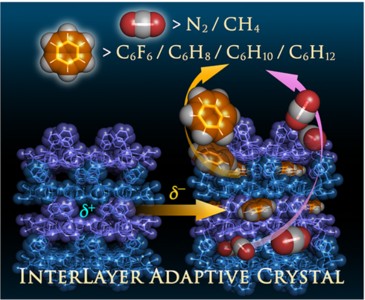
image2
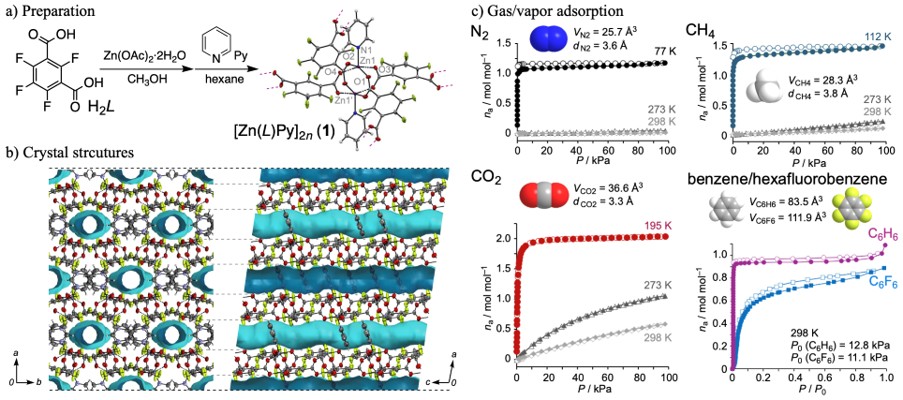
image3
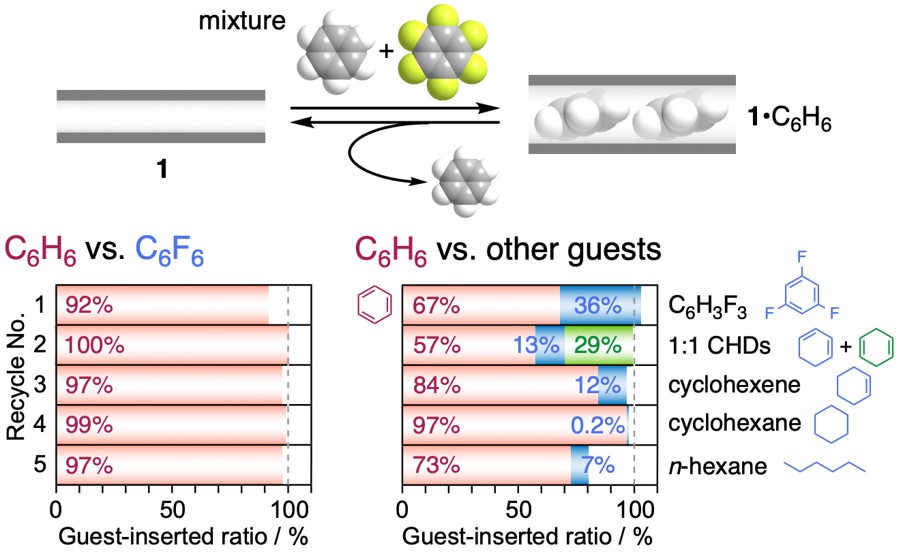
Title: Adaptive Crystal Selectively Recognizes Benzene
Caption: The interlayer adaptive crystal preferentially incorporates benzene from mixtures with hexafluorobenzene and other competing molecules, including cyclohexene and cyclohexane. Electrostatic interactions between the fluorinated crystal surfaces and guest molecules drive selective recognition and reversible guest incorporation.
Credit: Professor Akiko Hori from Shibaura Institute of Technology, Japan
Source Link: https://doi.org/10.1002/anie.4090353
License Type: CC BY 4.0
Usage restrictions: Credit must be given to the creator.