New Low-Temperature Coating Strategy for Tougher and Conductive Lightweight Magnesium
- Research
Researchers develop a low-temperature steam-assisted process that gives magnesium alloys durable, conductive spinel coatings for harsh acidic environments
Magnesium alloys are among the lightest structural metals available, but their poor corrosion resistance and electrically insulating surface films have limited their use in energy devices. Now, researchers have developed a low-temperature Steam-Assisted Solvothermal process combined with calcination that converts a magnesium hydroxide precursor into a robust, conductive MgFe₂O₄ spinel coating. The coating combines excellent corrosion resistance with electrical conductivity, making lightweight magnesium more suitable for polymer electrolyte fuel cells and other energy applications.
Magnesium alloys are attractive for advanced energy technologies because of their exceptional strength-to-weight ratio. However, despite being the lightest structural metals available, they corrode rapidly in acidic environments, while their native oxides and conventional protective coatings are electrically insulating. This combination has limited their use in demanding applications such as polymer electrolyte fuel cells (PEFCs), where components must resist corrosion while efficiently conducting electricity. Overcoming this longstanding trade-off has remained a major challenge in surface engineering.
Addressing this challenge, a research team led by Professor Takahiro Ishizaki from the College of Engineering, Shibaura Institute of Technology (SIT), Japan, developed an innovative two-step Steam-Assisted Solvothermal (SAS) process. The method first forms a dense magnesium hydroxide [Mg(OH)2] precursor through steam treatment, converts it into a magnesium ferrite (MgFe₂O₄) layer via solvothermal growth, and finally applies calcination at 773 K to yield a highly crystalline spinel coating. Unlike conventional ceramic synthesis, which requires temperatures above 1,300 K, the new approach achieves conversion at just 453 K, thereby avoiding thermal damage to the magnesium substrate. The study was made available online on July 13, 2026, and will be published in Volume 536 of the journal Surface and Coatings Technology on September 15, 2026.
The coating forms through a controlled dissolution-precipitation mechanism. During solvothermal treatment, the Mg(OH)2 precursor partially dissolves, releasing magnesium ions that react with iron species to grow MgFe₂O₄ directly on the alloy surface. This topotactic-like conversion produces a dense, continuous spinel layer instead of the unstable hydroxide coatings commonly produced by hydrothermal methods. Subsequent calcination at 773 K further enhances crystallinity, promotes particle coalescence, and strengthens grain connections, thereby producing a highly dense and ordered ceramic coating.
Electrochemical testing demonstrated remarkable performance. The optimized coating prepared at 453 K exhibited an ultralow corrosion current density of approximately 2.42 × 10⁻⁸ A cm⁻² in sulfuric acid at pH 3, significantly outperforming untreated AZ91D magnesium alloy and conventional layered double hydroxide coatings. The continuous MgFe₂O₄ network also achieved a sheet resistance of 4.40 × 10⁶ Ω/sq., creating conductive pathways that overcome the insulating nature of native magnesium oxides. Long-term immersion tests further showed that the coating remained chemically stable while suppressing iron ion release even after 200 hours in acidic solution.
“Our objective was to overcome the long-standing conflict between corrosion resistance and electrical conductivity on magnesium alloys without exposing the substrate to damaging high temperatures,” says Prof. Ishizaki. “By combining steam conversion with solvothermal growth, we created a highly crystalline spinel coating through controlled interfacial reactions at temperatures compatible with lightweight magnesium.”
The researchers believe the technology could expand the use of magnesium alloys in clean-energy systems. Lightweight coated magnesium components could replace heavier stainless steel, titanium, or carbon composite bipolar plates and interconnects in PEFCs, reducing system weight while maintaining durability in acidic operating environments. The approach could also benefit hydrogen-powered vehicles, aerospace technologies, and industrial systems requiring corrosion-resistant conductive surfaces. This strategy demonstrates how rational interfacial chemical design can tailor multifunctional ceramic coatings on reactive metals. The researchers expect further optimization of coating adhesion and pore sealing to extend long-term durability for practical energy applications.
Overall, the SAS process provides a practical low-temperature route for producing robust, electrically conductive MgFe₂O₄ spinel coatings directly on magnesium alloys. By eliminating the need for extremely high-temperature ceramic synthesis while delivering outstanding corrosion resistance and electrical conductivity, this environmentally benign surface engineering strategy opens new opportunities for lightweight materials in next-generation energy storage and conversion technologies, supporting more efficient hydrogen fuel cells and progress toward a decarbonized society.
“Our innovation holds significant potential for next-generation energy conversion and storage systems in the automotive and aerospace sectors and offers a protective and conductive ceramic coating for various magnesium components exposed to aggressive acidic industrial processing environments,” concludes Prof. Ishizaki.
Reference
|
Title of original paper: |
Synergistic mechanism of steam-assisted conversion and solvothermal growth for tailoring robust and conductive MgFe2O4 spinel layers on AZ91D alloys |
|
Journal: |
Surface and Coatings Technology |
|
DOI: |
Additional information for EurekAlert
|
Latest Article Publication Date: |
15 September 2026 |
|
Method of Research: |
Experimental study |
|
Subject of Research: Animals |
Not Applicable |
|
Conflicts of Interest Statement: |
There are no conflicts to declare. |
Authors
About Shibaura Institute of Technology (SIT), Japan
Shibaura Institute of Technology (SIT) is a private university with campuses in Tokyo and Saitama. Since the establishment of its predecessor, Tokyo Higher School of Industry and Commerce, in 1927, it has maintained “learning through practice” as its philosophy in the education of engineers. SIT was the only private science and engineering university selected for the Top Global University Project sponsored by the Ministry of Education, Culture, Sports, Science and Technology and had received support from the ministry for 10 years starting from the 2014 academic year. Its motto, “Nurturing engineers who learn from society and contribute to society,” reflects its mission of fostering scientists and engineers who can contribute to the sustainable growth of the world by exposing their over 9,500 students to culturally diverse environments, where they learn to cope, collaborate, and relate with fellow students from around the world.
Website: https://www.shibaura-it.ac.jp/en/
About Professor Takahiro Ishizaki from SIT, Japan
Dr. Takahiro Ishizaki is a Professor at the College of Engineering, Shibaura Institute of Technology (SIT), Japan. He received his Ph.D. from Waseda University, Japan, in 2004. His research focuses on surface chemistry, electrochemistry, functional material synthesis, materials chemistry, corrosion protection, and advanced surface engineering. His expertise includes coating technology, surface characterization, surface analysis, nanomaterials, and advanced coatings. Since January 2023, he has served as Director of the Japan Flux Growth Research Association. He has published 170 papers, with over 4,700 citations.
Funding Information
The authors gratefully acknowledge the financial support from the Light Metal Educational Foundation, Inc., Japan.
Media Contact: Kohei Tsuchiya
E-mail: koho@ow.shibaura-it.ac.jp
Web: https://www.shibaura-it.ac.jp/en/
image
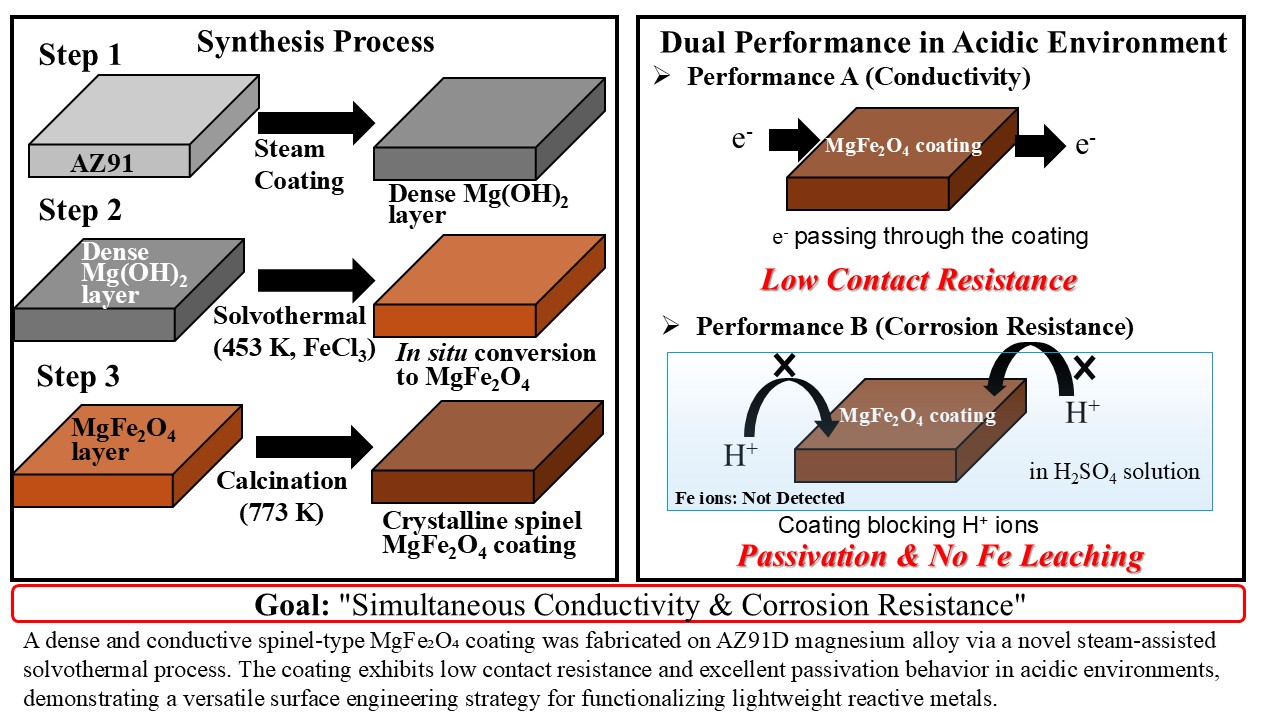
Title: Steam-assisted low-temperature synthesis creates a durable conductive spinel coating on magnesium alloy
Caption: Schematic of the two-step Steam-Assisted Solvothermal process converting a Mg(OH)₂ precursor into a dense MgFe₂O₄ spinel coating on AZ91D magnesium alloy. FE-SEM, EDS, and electrochemical analyses confirm the coating's dense and continuous structure, uniform elemental distribution, and enhanced corrosion resistance in acidic environments.
Credit: Prof. TakahiroIshizaki from Shibaura Institute of Technology, Japan
Source Link: NA
License Type: Original content
Usage restrictions: Cannot be reused without permission