Laser-Printed Touch Interface Turns Finger Motion into Digital Inputs
- Research
Researchers from Shibaura Institute of Technology in Japan develop a low-cost touch interface that recognizes finger movements and users
Touch interfaces in devices typically require power, wiring, and specialized components, limiting where they can be used. Researchers from Japan have developed a touch interface that can be made by printing toner patterns onto a PVC sheet with a conventional laser printer. The sheet can recognize finger movements, patterns, characters, and users, while remaining stable after 1,000 sliding cycles. The approach could enable inexpensive, customizable controls for wearable and Internet of Things (IoT) devices.
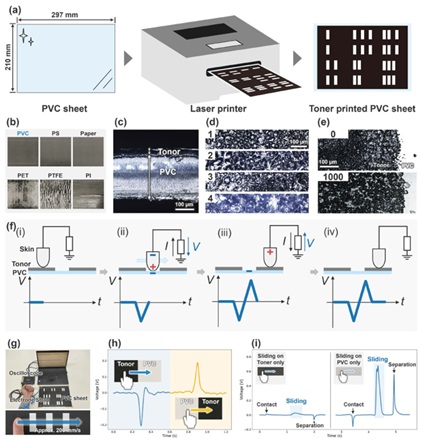
Title: Laser-printed PVC sheet enables triboelectric touch input
Caption: A conventional laser printer forms a thin toner film on a PVC sheet, creating patterned exposed regions that control triboelectric signal generation during finger sliding. The toner-printed sheet showed no significant waveform degradation after 1,000 sliding cycles.
Credit: Hiroki Shigemune from SIT, Japan
Source Link: https://doi.org/10.1016/j.nanoen.2026.112165
License Type: CC BY 4.0
Usage restrictions: Credit must be given to the creator.
Touchscreens and other touch-based controls, from smartphones and tablets to smart devices and wearable electronics, have become part of everyday life. However, many touch interfaces depend on batteries, external power, electrodes, and wiring, which can increase costs and make them difficult to install in places where conventional electronics are impractical. Finding a simpler way to create touch-sensitive controls could therefore open new possibilities for wearable devices and the growing Internet of Things (IoT).
Addressing this challenge, a research team led by Associate Professor Hiroki Shigemune and master's student Haruki Higoshi from the Department of Electrical Engineering, College of Engineering, Shibaura Institute of Technology, Tokyo, Japan, developed a single-electrode touch interface that can be created simply by printing patterns onto a PVC sheet with a conventional laser printer. When a person slides a finger across the printed surface, the interaction between the finger and the different areas of the sheet produces electrical signals based on the triboelectric effects (charge transfer between objects when they contact or slide against each other) of the human body. The sheet itself does not require electrical wiring or electrodes. The study was available online on June 27, 2026, and published in Volume 156 of the journal Nano Energy on September 01, 2026.
The researchers found that the design of the printed pattern could determine the signals produced by different finger movements. This allowed the team to recognize the direction and speed of a sliding finger and to create simple controls using different printed patterns. The researchers also demonstrated binary input, including a system that could convert a sequence such as 1010 into the decimal number 10. The interface remained mechanically stable through 1,000 sliding cycles, with no significant changes in the shape or strength of its signals.
“The toner pattern functions as a geometric mask that controls where the skin directly contacts PVC, thereby controlling the timing and polarity of the potential response,” explains Prof. Shigemune. In simpler terms, the printed pattern acts like a set of invisible instructions for the sheet, determining how it responds when someone touches and slides a finger across it. Changing the pattern can therefore change what the interface does, without requiring a completely different electronic device.
The team next tested whether the same approach could recognize more complex inputs. Using machine learning, the system identified seven different printed patterns with 97.1% accuracy and recognized all 26 alphabet characters with 89.2% accuracy. It also distinguished between seven participants, achieving 97.1% accuracy in identifying users. Differences in how people interact with the surface, including finger pressure, sliding speed, contact angle, and contact stability, were reflected in the signals. These findings suggest that the technology could potentially be used not only for controls but also for personalized or security-related interfaces.
“Our approach offers a low-cost, wiring-free platform in which the input function can be changed simply by modifying the printed pattern,” says Prof. Shigemune. This flexibility could make the technology useful for a range of applications, including wearable controls attached to clothing or the body, IoT devices, keyboards, game controllers, and smartphone operation. It could also support user-authentication functions by distinguishing between individual users.
Overall, the study shows how an everyday office technology, a laser printer, could be used to create a new kind of interactive surface. By combining simple printing with signals naturally generated during finger movement, the approach offers a low-cost and customizable alternative for touch-based input. The researchers believe it could contribute to future wearable electronics, IoT systems, consumer devices, and security applications, while further work will explore performance under more demanding real-world conditions.
Reference
|
Title of original paper: |
Toner-printed pattern recognition system based on triboelectricity of human body for human-computer interaction |
|
Journal |
Nano Energy |
|
DOI: |
Authors
About Associate Professor Hiroki Shigemune from SIT, Japan
Prof. Hiroki Shigemune is an Associate Professor in the Department of Electrical Engineering, College of Engineering, Shibaura Institute of Technology (SIT), Tokyo, Japan, where he has served since 2021. He is also the Director and Head of the Active Functional Devices Laboratory at SIT. His research interests span mechatronics, actuators, printing technologies, soft robotics, soft actuators, active matter, origami engineering, microfluidics, and printable circuits. His work focuses on developing flexible devices, functional materials, and fabrication technologies for next-generation engineering applications. He has authored 98 publications and received 859 citations, reflecting his contributions to advanced functional device research.
Funding Information
This study was supported by JSPS KAKENHI Grant Number JP24H00728.