New High-Temperature, High-Pressure Isotope Ratio Analysis Method for Halogenated Compounds
- Research
Researchers develop a custom liquid chromatography–isotope ratio mass spectrometry device capable of high-temperature, high-pressure combustion
Halogenated organic compounds (HOCs) are widely used in industrial and consumer products, but some are highly persistent and difficult to analyze and manage. In a new study, researchers have developed an innovative approach for carbon isotope ratio analysis of these compounds, which has been previously difficult. This approach will help track the source and environmental pathways of such pollutants, contributing to the development of effective management strategies.
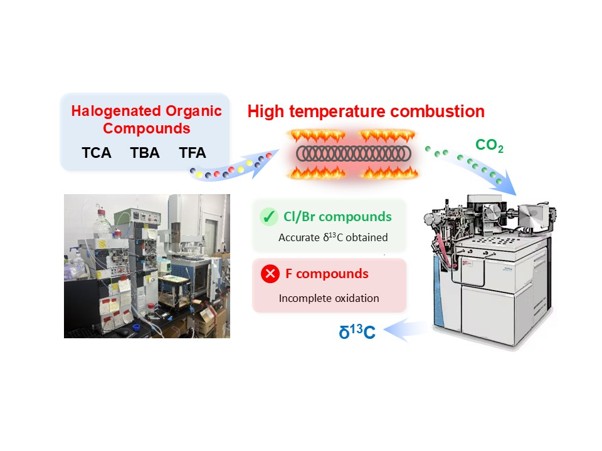
Title: Proposed high-temperature, high-pressure LC-IRMS device
Caption: The proposeds high-tempearture, high-pressure platform enables precise and accurate δ13C analysis of a wide range of chlorinated and brominated compounds.
Credit: Professor Hiroto Kawashima from SIT, Japan
Source Link: https://doi.org/10.1016/j.aca.2026.346061
License Type: CC BY 4.0
Usage restrictions: Credit must be given to the creator.
Halogenated organic compounds (HOCs) have been used in a wide range of products, including disinfection by-products (DBPs), pesticides, refrigerants, and industrial chemicals. Because of their persistence, tendency for bioaccumulation, and toxicity, HOCs have been recognized as contaminants of global concern. HOC exposure has been implicated in several health effects in humans. For example, haloacetic acids, a major class of DBPs, have been reported to increase the risk of bladder cancer. Perfluoroalkyl and polyfluoroalkyl substances, including trifluoroacetic acid, are another class of persistent HOCs that are highly resistant to degradation.
Conventional approaches for their environmental monitoring mainly rely on concentration measurements and offer limited information about pollution sources and environmental transformation processes. An effective approach for uncovering environmental behavior is carbon isotope analysis, traditionally conducted using gas- or liquid chromatography–isotope ratio mass spectrometry (GC-IRMS and LC-IRMS, respectively). Carbon isotope ratios (δ¹³C) can provide information about the origin and production history of chemicals, as even the same compound can have different δ¹³C values depending on its production process. Indeed, δ13C analysis has been reliably used to detect food fraud. However, δ13C analysis of HOCs containing strong carbon–chlorine or carbon–fluorine (C–F) bonds remain challenging because their oxidation is difficult under conventional LC-IRMS combustion conditions, where oxidation is carried out near 99°C.
To address this challenge, a research team led by Professor Hiroto Kawashima from the Department of Bioscience and Engineering, College of Systems Engineering and Science at Shibaura Institute of Technology (SIT), Japan, in collaboration with researcher from the National Institute of Advanced Industrial Science and Technology (AIST), Japan, has developed an innovative interface capable of high-temperature, high-pressure combustion, enabling accurate and precise δ¹³C analysis of several halogenated compounds. “We developed a custom-built high-temperature, high-pressure combustion interface for LC-IRMS,” explains Prof. Kawashima. “This unique system enables stable carbon isotope analysis of a wide range of halogenated compounds, providing a new tool for source identification and fate analysis.” The team included Mr. Sota Maehara from SIT and Dr. Sachi Taniyasu from AIST. Their study was made available online on August 02, 2026, and will be published in Volume 1421 of Analytica Chimica Acta on November 01, 2026.
To perform δ13C analysis of water-soluble halogenated compounds, the researchers developed a custom LC-IRMS interface. Specifically, an LC system with a post-column pump was connected to an IRMS via a high-temperature, high-pressure combustion interface. To achieve high-temperature oxidation, the researchers modified the combustion heater, while a back-pressure regulator maintained a pressure of 5.2 MPa throughout the flow path. Sodium persulfate was used as an oxidant to promote combustion, and the resulting products were subsequently cooled and processed for isotope ratio measurement.
Experiments revealed that the modified LC-IRMS interface successfully achieved oxidation of chlorinated and brominated compounds, including trichloroacetic acid (TCA) and tribromoacetic acid, with δ13C values within 1‰ of reference values over both negative and positive isotope ranges, and recoveries close to 100% across a wide range of temperatures ranging from 300–600°C. In contrast, fluorinated compounds proved more difficult to analyze with high precision because of the exceptional strength and thermal stability of C–F bonds, resulting in lower recoveries. Based on the above results, the optimized oxidation temperature of LC-IRMS was determined to be 500°C.
The researchers also evaluated the effects of sample concentration. The results showed that a minimum concentration of 500 mg/L was required for measurements to become possible under the tested conditions. Reliable isotope measurements also required approximately 50–60 nanomoles of carbon or more. Because environmental concentrations of TCA can be substantially lower than the concentrations required by the current method, further improvements such as sample pre-concentration will be necessary for direct analysis of environmental samples.
Additionally, the researchers further tested this high-temperature, high-pressure analysis platform by evaluating δ13C values of 19 samples, including 15 types of halogenated compounds. The results demonstrated highly precise, accurate, and reproducible measurements for chlorinated compounds, brominated compounds, and oxidation-resistant aromatic chlorinated compounds. Fluorinated compounds, on the other hand, could only be analyzed effectively when only one C–F bond was present. Notably, the results also showed that even for the same compound, δ13C could differ based on its origin and production process, necessitating caution.
“In the future, our platform has the potential to support environmental monitoring, source identification, and the development of more effective strategies for managing persistent pollutants," explains Prof. Kawashima. “Furthermore, because the combustion interface was custom-built in-house, it has a significantly lower cost than commercial options, making it more accessible for other laboratories seeking to expand their analytical capabilities for halogenated compounds. Although challenges remain, further optimizations will improve oxidation efficiency and expand applicability to a wide range of halogenated compounds.”
By establishing a high-temperature, high-pressure platform for δ¹³C analysis of halogenated compounds, this study offers a foundation for future applications of LC-IRMS to environmental source identification, source apportionment, and degradation studies.
Reference
|
Title of original paper: |
Measurement of stable isotope ratios of halogenated organic compounds by liquid chromatographic, high-temperature combustion isotope ratio mass spectrometry |
|
Journal: |
Analytica Chimica Acta |
|
DOI: |
Additional infotmation for EurekAlert
| Latest Article Publication Date: |
01 November 2026 |
| Method of Research: |
Experimental study |
| Subject of Research: |
NA |
| Conflicts of Interest Statement: |
The authors declare the following financial interests/personal relationships which may be considered as potential competing interests: Hiroto Kawashima reports financial support was provided by Government of Japan Ministry of Education Culture Sports Science and Technology. If there are other authors, they declare that they have no known competing financial interests or personal relationships that could have appeared to influence the work reported in this paper. |
Authors
About Professor Hiroto Kawashima from SIT, Japan
Dr. Hiroto Kawashima is a Professor in the Department of Bioscience and Engineering at the College of Systems Engineering and Science, Shibaura Institute of Technology, Japan, and collaborates with the National Institute of Advanced Industrial Science and Technology. He earned his Ph.D. from Yokohama National University and has over 20 years of research experience in environmental and analytical chemistry. His research focuses on stable isotope analysis and pollutant source identification using mass spectrometry. He has authored 45 papers with 728 citations to his credit.
Laboratory Web: https://kawashima-lab.labby.jp/
Funding Information
This work was supported by a Grant-in-Aid for Scientific Research (A) No. 21H04929 from the Ministry of Education, Culture, Sports, Science and Technology, Japan.