Synergistic LaCoO₃–Co₃O₄ Composite Approaches Platinum-Level Oxygen Catalysis Without Precious Metals
- Research
Researchers have developed a platinum-free heterostructured oxide catalyst for high-energy lithium–oxygen batteries
Lithium–oxygen batteries have great potential as next-generation energy storage devices; however, sluggish oxygen reactions have long hindered their commercial adoption. Researchers from Shibaura Institute of Technology developed a heterostructured lanthanum cobalt oxide-cobalt oxide composite that accelerates these reactions, achieving outstanding bifunctional catalytic performance with a record-low potential gap of just 1.14 V. The platinum-free catalyst could allow longer-range electric vehicles and extended-endurance drones, offering a cost-effective and sustainable path toward next-generation energy storage.
An electric vehicle that never needs recharging on a cross-country trip. Drones that fly for hours without landing. These scenarios demand energy storage far beyond what lithium-ion batteries can deliver—and lithium–oxygen batteries (LOBs) have long promised to bridge this gap. With a theoretical energy density up to ten times higher than lithium-ion technology, LOBs could revolutionize electric mobility. Yet one fundamental obstacle has prevented their commercial adoption: the notoriously slow and inefficient electrochemical oxygen reactions that cause significant energy losses during charging and discharging.
In an effort to bridge this gap, Professor Takahiro Ishizaki from Shibaura Institute of Technology (SIT), Japan, and his team investigated whether engineering a heterostructured composite catalyst could overcome one of the biggest obstacles facing LOBs. The researchers developed a highly efficient bifunctional catalyst capable of accelerating both oxygen reduction and oxygen evolution reactions that govern battery performance by uniformly combining the perovskite oxide lanthanum cobalt oxide (LaCoO3) with the spinel oxide cobalt oxide (Co3O4). Their findings were published in Volume 16, Issue 23 of the RSC Advances journal on April 22, 2026.
Explaining the motivation behind the study, Prof. Ishizaki says, “We were fundamentally motivated by the critical kinetic bottleneck holding back the realization of LOBs, namely the notoriously slow and inefficient electrochemical reactions involving oxygen gas.” He further adds, “While individual perovskite (LaCoO₃) and spinel (Co₃O₄) oxides were already known to possess decent catalytic properties independently, their intimate combination into a well-defined interfacial composite specifically tailored for lithium–oxygen systems had received little systematic attention. The question of whether their synergistic interaction could unlock performance beyond what either material achieves alone was what we set out to answer.”
To investigate this possibility, the researchers synthesized LaCoO3, Co3O4, and a composite of the two materials using a scalable coprecipitation method. They then systematically compared their structural and electrochemical properties using advanced characterization techniques, including X-ray diffraction, electron microscopy, X-ray photoelectron spectroscopy, and electrochemical analyses. The team evaluated each material’s performance as a bifunctional catalyst by measuring its ability to power oxygen evolution during charging as well as oxygen reduction during discharging. The electronic interactions responsible for the catalytic activity were also examined.
Among all the synthesized materials, the composite catalyst delivered the best overall performance, with an exceptionally narrow potential gap of just 1.14 V, a key indicator of highly efficient bifunctional catalysis. Remarkably, this outstanding performance was achieved despite the composite exhibiting the lowest electrochemical surface area among all tested materials. This counterintuitive result reveals that catalytic performance is governed not by the quantity of active surface sites, but by the quality of their electronic structure—a finding that fundamentally challenges conventional catalyst design principles. The composite catalyst also outperformed commercial ruthenium oxide during the oxygen evolution reaction while exhibiting oxygen reduction activity approaching that of platinum-based catalysts. According to Prof. Ishizaki, “The primary and most immediate application of these findings lies in the development of highly efficient air cathodes for next-generation LOBs, which could ultimately power long-range electric vehicles and extended-endurance drones that require energy capacities far exceeding what current lithium-ion technology can provide. While urban air mobility remains a longer-term aspiration, this work represents a critical step toward realizing the transformative potential of LOBs.” The researchers attribute this exceptional performance to the synergistic interaction between the two metal oxides, which created abundant oxygen vacancies and optimized the material’s electronic structure, enabling oxygen reactions to proceed much more smoothly.
Beyond LOBs, the newly developed catalyst holds great promise for a wide range of clean energy technologies. Since it is composed of non-precious lanthanum and cobalt instead of expensive noble metals, it offers a cost-effective and sustainable alternative for future energy devices. Its excellent oxygen evolution performance also suggests potential applicability in green hydrogen production via water electrolysis, though further investigation in that direction is needed. Furthermore, its efficient bifunctional catalytic activity holds promise for enabling large-scale metal¬¬–air batteries and reversible fuel cells for storing renewable energy generated from solar and wind sources.
Overall, the study provides a strategy for overcoming one of the long-standing challenges limiting next-generation battery technology. “By dramatically narrowing the potential gap between charging and discharging to just 1.14 V, this catalyst directly tackles the kinetic inefficiency of oxygen reactions that has long stood as a critical barrier to practical LOBs,” says Prof. Ishizaki. Such advances could pave the way for safer, longer-lasting, and significantly more efficient energy storage systems.
Reference
|
Title of original paper: |
Synergistic LaCoO3@Co3O4 bifunctional catalyst for efficient oxygen evolution and reduction: achieving low polarization |
|
Journal: |
RSC Advances |
|
DOI: |
|
|
Author(s) name
|
Akihito Shio, Hayato Takada, Yuna Fujiwara, Taketo Imamura, Toshiki Iwato, Kouki Yamamoto, Gasidit Panomsuwan, and Takahiro Ishizaki |
Authors
About Shibaura Institute of Technology (SIT), Japan
Takahiro Ishizaki is a Professor in the Department of Materials Science and Engineering, College of Engineering, Shibaura Institute of Technology (SIT), Japan. He holds a Doctor of Engineering degree and has over 20 years of research experience in materials science. Before joining SIT, he served as a postdoctoral research associate and assistant professor at Nagoya University, and as a research scientist at the National Institute of Advanced Industrial Science and Technology (AIST), Japan. He has authored more than 160 scientific publications, with an h-index of 34 and over 4,700 citations. His research focuses on electrochemistry, surface chemistry, nanomaterials, energy storage materials, corrosion-resistant coatings, and functional materials for green technologies. He currently leads research on next-generation battery materials, carbon-based energy materials, and AI-driven materials development, contributing to sustainable energy solutions and advanced materials for green transformation.
Funding Information
Media Contact: Kohei Tsuchiya
E-mail: koho@ow.shibaura-it.ac.jp
Web: https://www.shibaura-it.ac.jp/en/
image
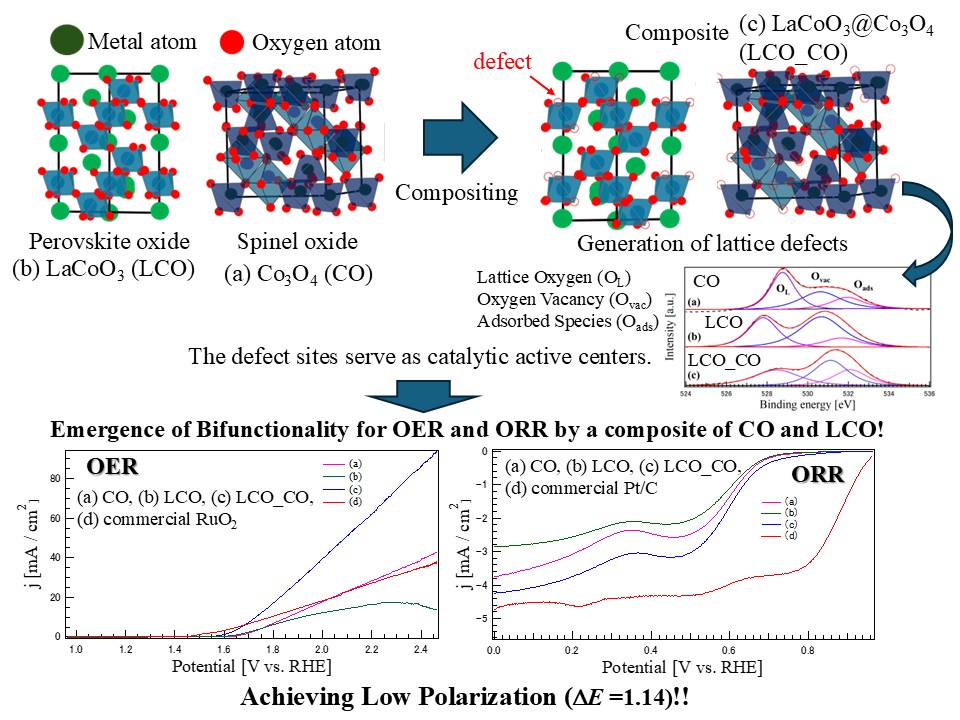
Title: Heterostructured lanthanum cobalt oxide-cobalt oxide composite catalyst enhances performance of lithium–oxygen batteries
Caption: A team of researchers has developed a low-cost heterostructured cobalt-based catalyst that improves lithium–oxygen battery performance, advancing future clean energy storage.
Credit: Professor Takahiro Ishizaki from Shibaura Institute of Technology, Japan
Source Link: https://pubs.rsc.org/ra/article/16/23/20616/1243327/Synergistic-LaCoO3-Co3O4-bifunctional-catalyst-for
License Type: CC BY 4.0
Usage restrictions: Credit must be given to the creator.