New Field-Tested Design Framework Improves Bored Pile Foundations in Weathered Rock
- Research
Analysis of 20 instrumented pile load tests shows that weathering-adjusted rock strength enables more reliable bored pile foundation design
Large bored piles are widely used to support bridges, high-rise buildings, and transport infrastructure, but estimating their capacity in weathered rock remains uncertain. Researchers from Shibaura Institute of Technology analyzed 20 instrumented static load tests on piles socketed in weathered siltstone and sandstone. Their findings provide field-calibrated adhesion factors and weathering-adjusted shaft-resistance correlations, enabling safer, more economical foundation designs while reducing unnecessary concrete and steel use.
Large-diameter bored piles are essential for major infrastructure, from elevated railways and long-span bridges to high-rise buildings. Yet, when these piles extend into weak, weathered sedimentary rocks such as siltstone and sandstone, engineers face a persistent design challenge: the rock behaves neither like conventional soil nor like strong, intact rock. Instead, its load-bearing capacity depends heavily on in-situ weathering, fracturing, and the interaction between the pile and the surrounding rock. Many current design methods estimate shaft resistance using the uniaxial compressive strength of intact rock. However, intact rock strength alone does not accurately represent the weaker, weathered rock mass surrounding a pile socket. As a result, engineers may adopt overly conservative designs, leading to larger pile diameters, greater pile lengths, increased material use, and higher construction costs.
To address this gap, a research team led by Professor Shinya Inazumi from Shibaura Institute of Technology (SIT), Japan, developed empirical design correlations for bored piles installed in weathered siltstone and sandstone. The study was made available online on June 15, 2026, and will be published in Volume 31 of the Results in Engineering journal on September 1, 2026. The team analyzed data from 20 instrumented static axial load tests on bored piles with diameters of 1.2–1.5 m and lengths of 9.3–36.0 m. “The combined effects of rock weathering, in-situ rock strength, and adhesion factor (α) on the shaft resistance of bored piles in weak rock remain poorly understood, motivating the need for further site-specific empirical studies,” said Prof. Inazumi.
All piles were constructed using the wet-process method and equipped with strain gauges and extensometers, allowing the researchers to measure unit shaft resistance and layer displacement along the pile depth. For weak rock layers where the measured displacement did not reach 5 mm, the team used hyperbolic fitting to estimate shaft resistance at this representative working displacement. A key aspect of the study was the explicit incorporation of rock weathering. The researchers adjusted the intact rock strength using a weathering-based reduction factor to calculate an equivalent in-situ rock strength. This enabled them to compare conventional estimates based on intact rock strength with weathering-adjusted estimates that more accurately reflected field conditions at the pile-rock interface.
The results revealed clear differences between the two rock types. For siltstone, 11 layers yielded adhesion factors ranging from 0.08 to 0.42, whereas six sandstone layers showed adhesion factors between 0.04 and 0.10. In practical terms, siltstone mobilized adhesion factors roughly twice those of sandstone under comparable conditions. Moreover, the weathering-adjusted correlations reduced prediction bias and variability compared with estimates based solely on intact rock strength. The proposed framework can be applied in two stages. During preliminary design, engineers can estimate shaft resistance using intact rock strength and rock type. During detailed design, they can incorporate the degree of weathering along the pile socket, calculate weathering-adjusted rock strength, and apply the proposed adhesion-factor correlations. This provides a more field-calibrated pathway from subsurface investigation to foundation design.
The findings are especially relevant for bridges, high-rise buildings, retaining structures, quay walls, transportation hubs, water-treatment plants, and energy facilities built on weak sedimentary rock profiles. By improving confidence in shaft-resistance estimates, the approach can help reduce unnecessary overdesign while maintaining safety and serviceability. “The proposed empirical correlations provide a field-based framework for estimating the shaft resistance of large-diameter bored piles in weak sedimentary rock formations, highlighting the importance of explicitly accounting for rock weathering in pile design,” notes Prof. Inazumi.
The authors caution that the proposed correlations should be applied only within the tested geological conditions and parameter ranges, and that additional validation is needed for other weak rock types such as mudstone and shale. Nevertheless, the study offers a practical, field-based framework for improving foundation design in weathered sedimentary rock formations. By enabling more reliable estimates of pile capacity, it has the potential to support safer infrastructure while reducing unnecessary material use and construction costs.
Reference
|
Title of original paper: |
Adhesion factors for bored piles in weathered siltstone and sandstone based on instrumented load tests |
|
Journal: |
Results in Engineering |
|
DOI: |
Additional information for EurekAlert
|
Latest Article Publication Date: |
01 September 2026 |
| Method of Research: |
Experimental study |
| Subject of Research: Animals | Not applicable |
| Conflicts of Interest Statement: |
The authors declare that they have no known competing financial interests or personal relationships that could have appeared to influence the work reported in this paper. |
Authors
About Shibaura Institute of Technology (SIT), Japan
Shibaura Institute of Technology (SIT) is a private university with campuses in Tokyo and Saitama. Since the establishment of its predecessor, Tokyo Higher School of Industry and Commerce, in 1927, it has maintained “learning through practice” as its philosophy in the education of engineers. SIT was the only private science and engineering university selected for the Top Global University Project sponsored by the Ministry of Education, Culture, Sports, Science and Technology and had received support from the ministry for 10 years starting from the 2014 academic year. Its motto, “Nurturing engineers who learn from society and contribute to society,” reflects its mission of fostering scientists and engineers who can contribute to the sustainable growth of the world by exposing their over 9,500 students to culturally diverse environments, where they learn to cope, collaborate, and relate with fellow students from around the world.
Website: https://www.shibaura-it.ac.jp/en/
About Professor Shinya Inazumi from SIT, Japan
Dr. Shinya Inazumi is a Professor at the College of Engineering, Shibaura Institute of Technology (SIT), Japan, where he leads the Geotechnical Engineering Laboratory. He obtained his Master’s and PhD degrees in Engineering from Kyoto University in 2000 and 2003, respectively. With over two decades of academic and research experience, he has authored more than 250 journal papers. His research focuses on geotechnical engineering, geo-disaster mitigation, sustainable social infrastructure, soil and ground improvement, numerical simulations, and AI applications in infrastructure planning. His notable achievements include best paper recognition at GEOMATE 2023 and editorial board honors.
Funding Information
NA
Media Contact: Kohei Tsuchiya
E-mail: koho@ow.shibaura-it.ac.jp
Web: https://www.shibaura-it.ac.jp/en/
image
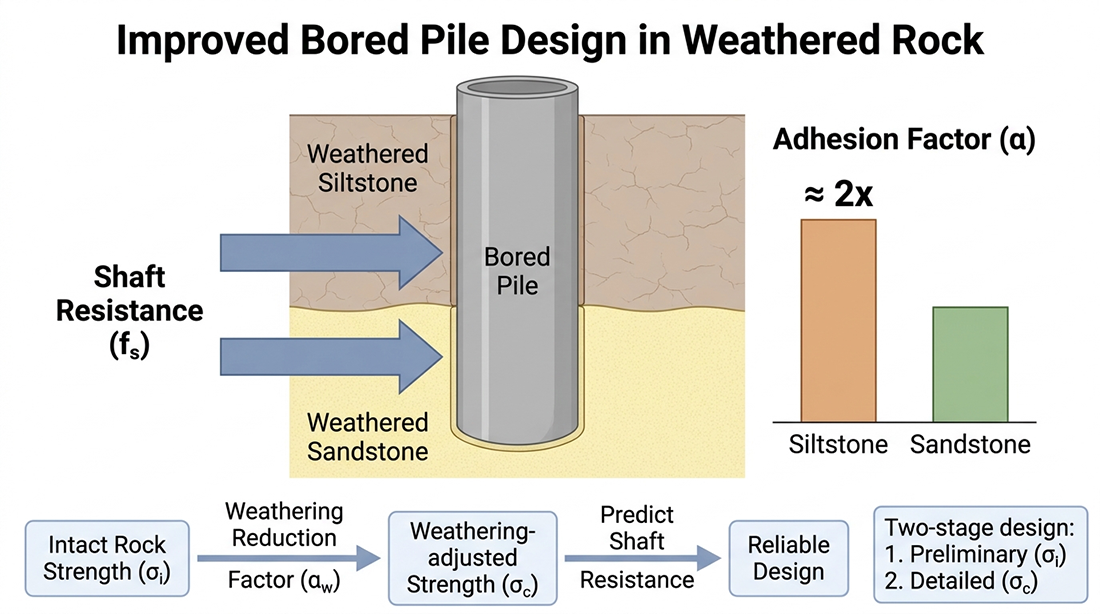
Title: Data-driven adhesion factors for safer and more efficient bored pile design in weathered siltstone and sandstone
Caption: Researchers from Shibaura Institute of Technology analyzed instrumented load-test data from large-diameter bored piles in weathered siltstone and sandstone to develop practical adhesion factors and shaft-resistance correlations for foundation design.
Credit: Professor Shinya Inazumi from Shibaura Institute of Technology, Japan
Source link: N/A
License Type: Original content
Usage restrictions: Credit must be given to the creator.