Winged Composite Pile System for Better Waste Management and Enhanced Uplift Resistance
- Research
Researchers develop a winged composite pile system that recycles excavated soil while improving foundation uplift resistance
Contemporary civil engineering practices highlight the need for safer, more reliable, uplift-resistant foundations for lifeline infrastructure and also seek solutions for environmental and social problems associated with surplus soil from construction projects. Using surplus construction soil, researchers have developed a winged composite pile system that can enhance uplift resistance. This approach supports cleaner and safer construction practices, helping projects achieve environmental goals without sacrificing structural integrity.
Management of surplus soil, often produced in large volumes at construction projects, represents a significant challenge in Japan. National statistics and recent incidents revealed that the utilization of surplus soil on-site lags far behind that of other construction byproducts. Improper disposal of surplus has resulted in slope failures, groundwater contamination, and land subsidence in residential areas, underscoring soil waste as a real environmental concern rather than a simple logistical issue.
Contemporary civil engineering practices also highlight the need for safer, more reliable, uplift-resistant foundations for lifeline infrastructure to mitigate natural disasters and high-wind events. However, current technical guidance for expanded-base piles under uplift is highly limited, particularly when low-strength recycled backfill is utilized.
To address these two pressing challenges, a research team led by Professor Shinya Inazumi from the College of Engineering, Shibaura Institute of Technology, Japan, developed a winged composite pile system using construction surplus soil. “Our concept emerged from discussions with industry partners who sought structural reliability and sustainable site management. Additionally, rather than using ad hoc solutions, we also wanted to provide engineers with quantitative, mechanism-based design guidance,” mentioned Prof. Inazumi, explaining the motivation behind this study. The study was published in Volume 33 of the journal Cleaner Engineering and Technology on June 5, 2026.
The proposed system consists of a winged steel pipe pile installed inside a permanent steel casing. Instead of filling the space around the pile with newly supplied material, the annular gap is backfilled with construction surplus soil generated during excavation.
To test the concept, the researchers conducted 224 three-dimensional elasto-plastic finite element analyses. They varied pile length, shaft diameter, and expanded wing diameter to understand how each factor influenced uplift resistance. The surrounding ground was modelled as dense sandy soil, while the surplus soil backfill was modelled as loose sandy soil, representing typical site soil condition and excavated soil characteristics, respectively.
The analysis revealed the optimal wing diameter for different pile lengths. For 10 m piles, the optimal wing diameter was approximately 1.6–1.7 m, shifted to 1.9–2.0 m for 15–20 m piles. Beyond the optimal wing diameter, the uplift resistance decreased as the gap between the wing and casing became too narrow, limiting the soil shear zone that provides resistance.
Surprisingly, shaft diameter had little effect on uplift resistance. Across shaft diameters from 0.2 m to 0.6 m, the variation in maximum uplift resistance remained within 10%. This has important design as well as recycling implications. Because uplift resistance is controlled mainly by the wing rather than the shaft, engineers may be able to reduce shaft diameter, lower steel use, and increase the volume of surplus soil that can be reused inside the casing without significantly compromising uplift capacity.
The findings of this study facilitate the design and construction of foundations for transmission towers and similar structures affected by wind uplift and overturning moments. Utilizing winged composite pile systems will allow engineers to substitute imported materials with surplus on-site soil, optimizing uplift resistance while meeting recycling goals. This system is particularly suited for greenfield infrastructure developments and upgrades to aging power and telecommunications networks with limited land. Additionally, it can also be applied to renewable energy facilities.
This technology supports circular economy concepts through on-site soil management and reducing transport waste, helping projects achieve environmental goals without sacrificing structural integrity.
Prof. Inazumi highlights, “Our research demonstrates that high-performance foundations and responsible soil management can coexist, countering the trend of off-site surplus soil disposal that harms the environment.”
Overall, the study proposes a system that can tackle two challenges observed in modern construction projects. By reusing excavated soil directly within the foundation system, winged composite piles can reduce off-site soil transport, minimize waste, and support cleaner and safer construction practices.
Reference
|
Title of original paper: |
On-site recycling of construction surplus soil in winged composite piles for enhanced uplift resistance |
|
Journal: |
Cleaner Engineering and Technology |
|
DOI: |
Additional information for EurekAlert
|
Latest Article Publication Date: |
5 June 2026 |
| Method of Research: |
Experimental Study |
| Subject of Research: Animals | Not applicable |
| Conflicts of Interest Statement: |
The authors declare that they have no known competing financial interests or personal relationships that could have appeared to influence the work reported in this paper. |
Authors
About Shibaura Institute of Technology (SIT), Japan
Shibaura Institute of Technology (SIT) is a private university with campuses in Tokyo and Saitama. Since the establishment of its predecessor, Tokyo Higher School of Industry and Commerce, in 1927, it has maintained “learning through practice” as its philosophy in the education of engineers. SIT was the only private science and engineering university selected for the Top Global University Project sponsored by the Ministry of Education, Culture, Sports, Science and Technology and had received support from the ministry for 10 years starting from the 2014 academic year. Its motto, “Nurturing engineers who learn from society and contribute to society,” reflects its mission of fostering scientists and engineers who can contribute to the sustainable growth of the world by exposing their over 9,500 students to culturally diverse environments, where they learn to cope, collaborate, and relate with fellow students from around the world.
Website: https://www.shibaura-it.ac.jp/en/
About Professor Shinya Inazumi from Shibaura Institute of Technology (SIT), Japan
Professor Shinya Inazumi is a Professor at Shibaura Institute of Technology (SIT), Japan. He graduated from Kyoto University in 2003. His laboratory, the Geotechnical Engineering Laboratory, focuses on the development and management of sustainable soil-based social infrastructure in harmony with the natural and social environment. His laboratory utilizes simulation techniques, along with data science and artificial intelligence, for its research. He has more than 200 publications and is a recipient of multiple awards. He is a member of multiple academic societies, including the Japan Society of Civil Engineers and the Geotechnical Society of Japan.
Funding Information
N/A
Media contact: Kohei Tsuchiya
E-mail: koho@ow.shibaura-it.ac.jp
Web: https://www.shibaura-it.ac.jp/en/
image
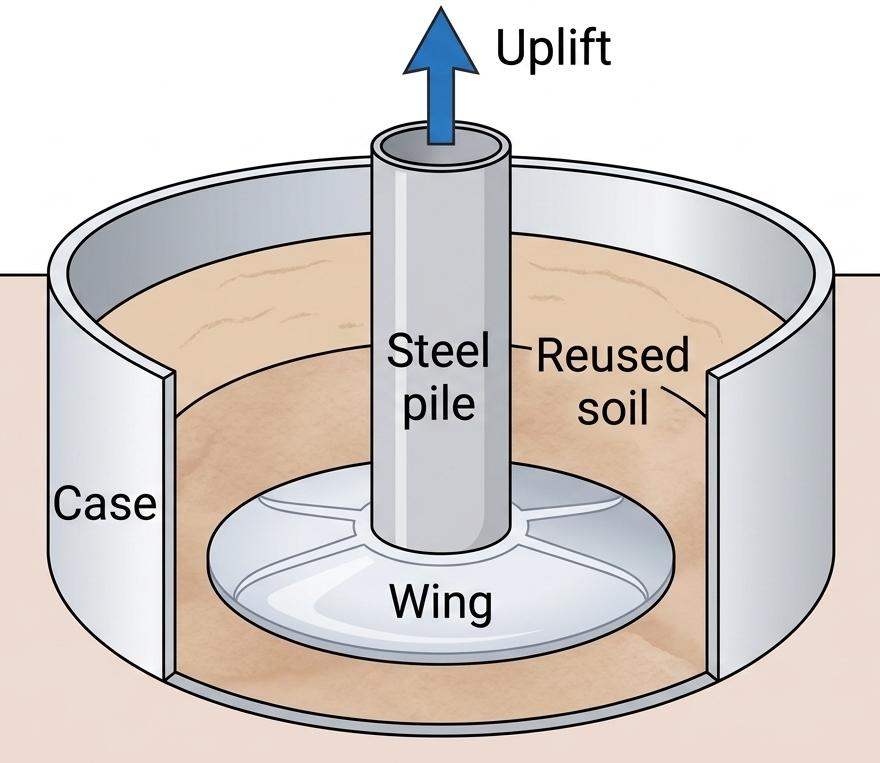
Title: Recycled winged composite pile system to reduce soil waste and enhance uplift strength
Caption: Researchers from Shibaura Institute of Technology developed a winged composite pile system, utiliizng construction surplus soil that can improve uplift resistance, support cleaner and safer construction practices.
Credit: Professor Shinya Inazumi from Shibaura Institute of Technology, Japan
Source link: N/A
License type: Original content
Usage restrictions: Credit must be given to the creator.