New Analysis Framework for Developing Stronger Foundations During Urban Redevelopment
- Research
Researchers present a comprehensive framework for evaluating and alleviating drilling instability during replacement of piles in building foundations
Urban redevelopment in densely populated areas often involves removing existing piles, backfilling boreholes, and installing new piles. Strength differences between backfilled soil and original ground can lead to drilling deviations, compromising building integrity and leading to economic losses. However, current countermeasures are based on experience-based judgements. In a new study, researchers present a new quantitative framework for evaluating drilling instability induced by backfilling, offering practical guidelines for improving resource efficiency, resilience, and sustainability.
Urban redevelopment in densely populated areas often requires demolition and replacement of aging buildings. As buildings are replaced, existing foundation piles must be removed, leaving cylindrical voids that must be backfilled prior to installation of new cast-in piles. However, with backfilled soil, it is difficult to achieve the same ground properties as the undisturbed original ground due to limited space, depth constraints, and compaction issues. Strict construction schedules further limit sufficient backfill consolidation.
These differences between the backfilled and native ground can create significant geotechnical challenges during subsequent pile installation. When drilling for new piles occurs near or partially through backfill zones, inadequate consolidation can lead to inclined drilling. This arises from the strength differences between the backfilled soil and the original ground, resulting in unbalanced force application at pin joints in drilling equipment. As a result, piles can become inclined, with field observations reporting deviations exceeding 10 millimeters per meter of depth.
Such deviations have severe structural and economic consequences: inclined piles do not have required bearing capacity, posing safety concerns and necessitating costly corrective measures. Corrective actions, including re-drilling and pile re-installation, can shift schedules by weeks and months and generate additional material costs. In congested urban sites, remediation may be difficult or impossible, necessitating redesign of the entire foundation system. Despite the significance of this issue, current preventive measures remain largely empirical and may result in either overly conservative or insufficiently robust specifications.
To address this gap, a research team led by Professor Shinya Inazumi from the College of Engineering at Shibaura Institute of Technology in Japan developed the first quantitative framework to predict drilling stability in backfilled ground during urban redevelopment. “Our framework transforms what was previously an experience-based judgment into a measurable design problem,” explains Prof. Inazumi. “By employing finite element analysis integrated with the shear strength reduction method, our approach clearly reveals how strength differences in backfilled soil and surrounding native soil can misalign drilling equipment.” Their study was made available online on May 12, 2026, and published in Volume 30 of the journal Results in Engineering in June 01, 2026.
The proposed framework includes three main components. The first component involves parametric analysis with systematic variation of backfilled ground strength. Specifically, the researchers considered five parametric cases where the backfilled-to-native soil strength ratio was set at 0.8, 0.9, 1.0, 1.1, and 1.2. In addition, they considered both sandy and clayey soils for the original ground.
Second, the team adopted an advanced numerical methodology combining three-dimensional elastoplastic finite element analysis (FEA) and shear strength reduction method (SRM). In SRM, soil shear strength parameters are reduced by a strength reduction factor until failure occurs within the finite element model. Finally, the framework enables analytical evaluation of heterogeneous ground conditions by considering vertical drilling loads in scenarios where the drilling equipment penetrates both backfilled and original ground.
The analysis revealed key mechanisms responsible for inclined drilling. Inclined drilling was found to occur when asymmetric shear failure develops in weaker ground. For backfilled-to-native soil strength ratios below 0.9, the plastic strain and surface displacement on the weaker side were significantly larger than on the weaker side, indicating a high likelihood of drilling deviation. Strength ratios above 0.9 reduced this asymmetry to acceptable levels. Furthermore, clayey soils were more susceptible to drilling instability than sandy soils for the same strength ratios when backfilled ground strength was weaker.
Based on these results, and considering additional safety margins, the researchers propose the design criterion for backfilled ground strength to be at least 1.1 times the original ground strength. They also presented target friction angles and backfilling material properties for both sandy and clayey original ground. Additionally, they also outlined alternative mitigation strategies, including drilling procedure modifications and ground improvement techniques, for scenarios where increasing strength ratios might be technically challenging or economically infeasible.
“While the design criterion proposed in our study serves as a general guideline, the proposed integrated FEA-SRM approach can be effectively applied as a site-specific evaluation tool for redevelopment projects in dense cities,” remarks Prof. Inazumi. “This study offers clear targets for material selection, quality control, and a scientific basis for updating engineering guidelines and construction practices, which will ultimately reduce the need for re-drilling, remedial work, and delays.”
By helping engineers better manage the risks associated with pile replacement and foundation reconstruction, the findings in this study could contribute to safer, more efficient, and sustainable urban renewal practices.
Reference
|
Title of original paper: |
Quantitative assessment of drilling stability in backfilled soils for sustainable urban building redevelopment |
|
Journal: |
Results in Engineering |
|
DOI: |
Additional information for EurekAlert
|
Latest Article Publication Date: |
01 June 2026 |
| Method of Research: |
Computational simulation/modelling |
| Subject of Research: Animals | NA |
| Conflicts of Interest Statement: |
The authors declare that they have no known competing financial interests or personal relationships that could have appeared to influence the work reported in this paper. |
Authors
About Shibaura Institute of Technology (SIT), Japan
Shibaura Institute of Technology (SIT) is a private university with campuses in Tokyo and Saitama. Since the establishment of its predecessor, Tokyo Higher School of Industry and Commerce, in 1927, it has maintained “learning through practice” as its philosophy in the education of engineers. SIT was the only private science and engineering university selected for the Top Global University Project sponsored by the Ministry of Education, Culture, Sports, Science and Technology and had received support from the ministry for 10 years starting from the 2014 academic year. Its motto, “Nurturing engineers who learn from society and contribute to society,” reflects its mission of fostering scientists and engineers who can contribute to the sustainable growth of the world by exposing their over 9,500 students to culturally diverse environments, where they learn to cope, collaborate, and relate with fellow students from around the world.
Website: https://www.shibaura-it.ac.jp/en/
About Professor Shinya Inazumi from SIT, Japan
Prof. Shinya Inazumi is a distinguished Professor at the College of Engineering, Shibaura Institute of Technology (SIT), Japan. He earned his Ph.D. degree from Kyoto University in 2003. Renowned for his contributions to geotechnical and geo-disaster engineering, his research spans social infrastructure engineering, geo-information studies, and disaster mitigation. Prof. Inazumi has authored over 300 scholarly publications and actively serves on numerous academic and professional committees. His pioneering work has earned him multiple awards, recognizing his leadership and innovation in the field. Prof. Inazumi remains at the forefront of advancing resilient infrastructure and sustainable engineering practices in Japan and beyond.
Funding Information
Media Contact: Kohei Tsuchiya
E-mail: koho@ow.shibaura-it.ac.jp
Web: https://www.shibaura-it.ac.jp/en/
image
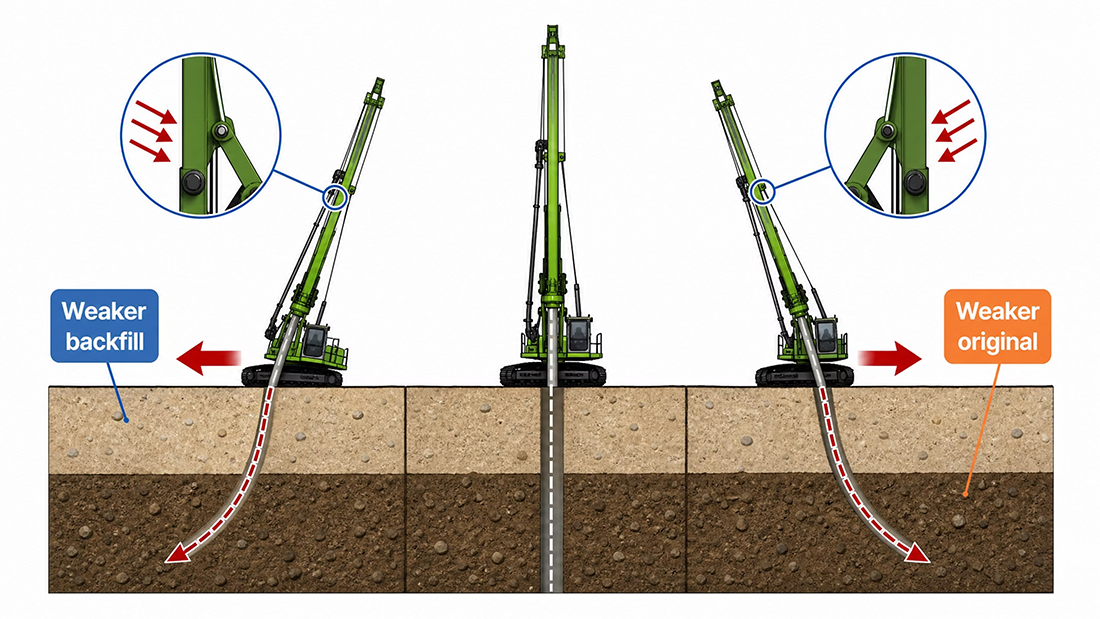
Title: How strength differences between backfilled and original ground affect pile installation
Caption: Strenght differences between backfilled soil and original ground can lead to inlined drilling and unserviceable piles. The framework proposed in the study offers practical guidelines to develop backfill specifications, improve resilience, and sustainability during foundation renewal programs.
Credit: Professor Shinya Inazumi from Shibaura Institute of Technology
Source Link: NA
License Type: Original content
Usage restrictions: Cannot be reused without permission