Beyond Balance: Smart Bicycle Understands Rider Intent
- Research
A machine-learning-based steer-by-wire bicycle system recognizes intentional turns and instability, providing support only when necessary
Two-wheeled vehicles naturally lean during turns, making it challenging for rider-assistance systems to tell if the rider is making a planned turn or losing balance. In a recent study, scientists from Shibaura Institute of Technology in Japan created a machine-learning-based steer-by-wire bicycle that can differentiate between these situations. This innovation could make electric bicycles and motorcycles safer without disrupting the riders’ intended movements.
Two-wheeled vehicles with conventional stability-control systems must lean to change direction, making it difficult for rider-assistance systems to determine whether a rider is intentionally cornering or experiencing instability that could lead to a fall. To address this challenge, researchers from Shibaura Institute of Technology (SIT), Japan, have developed a rider-intent-aware control system that can distinguish between the two and provide stabilization support only when needed.
The study was led by Associate Professor Hiroaki Kuwahara from the Department of Machinery and Control Systems, Shibaura Institute of Technology, Japan, together with Shota Tsukase, a second-year master's student in the Graduate School of Systems Engineering and Science at the same institution. The researchers sought to overcome a key limitation of conventional stability-control systems, which often respond to vehicle motion alone and may interfere with a rider's intended maneuvers. Their findings were published online on June 21, 2026, in the IEEE/ASME Transactions on Mechatronics journal.
“We believed that haptic technology could do more than providing force feedback—it could help us understand a rider’s intentions,” says Prof. Kuwahara. “By analyzing the interaction between the rider and the vehicle, we aimed to create a mobility system that provides support only when it is truly needed.”
To achieve this, the team developed a steer-by-wire bicycle. Unlike a conventional bicycle, where the handlebars are mechanically connected to the front wheel, the steer-by-wire system electronically links the two. This configuration allows the system to measure steering behavior and rider–vehicle interactions while maintaining realistic steering sensations through haptic feedback or force-based feedback that lets riders feel how the vehicle is responding.
The steer-by-wire platform was integrated with a machine-learning-based rider-intent classification system. At its core is a long short-term memory (LSTM) neural network, a type of machine-learning model designed to identify patterns in time-dependent data. Before training the model, the researchers used K-means clustering, an unsupervised learning technique, to categorize riding data into three scenarios: straight riding, cornering, and instability.
Using data collected from riding experiments, the LSTM model analyzed variables such as steering angle, vehicle speed, roll angle, lateral acceleration, and reaction torque. These measurements enabled the system to capture both the state of the bicycle and the interaction between the rider and the vehicle. By combining these sources of information, the model learned to recognize riding conditions in real time.
The results demonstrated that the system could accurately classify different riding scenarios and, importantly, distinguish intentional cornering from unstable riding conditions—even though both involve leaning motions. This distinction is crucial because unnecessary intervention during a turn can disrupt the riding experience, while timely intervention during instability can help prevent loss of control.
“Because two-wheeled vehicles naturally lean during turns, it is essential to distinguish between intentional maneuvers and instability that could lead to a fall,” explains Prof. Kuwahara. “Our system uses information from the vehicle and rider interactions to make that distinction and provide stabilization support only when necessary.”
Once a riding condition was identified, the control system responded accordingly. During intentional steering and cornering, the stabilization controller remained inactive, preserving the rider’s control of the vehicle. When instability was detected, however, the system automatically activated stabilization control to help restore balance. Experiments showed that the approach could recognize riding situations and provide support at appropriate moments without disrupting natural handling.
The researchers believe the technology could eventually be applied to electric bicycles, electric motorcycles, bike-sharing services, and delivery vehicles. It may also prove beneficial for older riders and less experienced users who could benefit from additional stability support while retaining a natural riding experience.
“Our goal is to move beyond conventional automated control toward human-cooperative control,” says Prof. Kuwahara. “Rather than replacing the rider, the system interprets the rider’s intentions and provides assistance only when instability occurs. We hope this approach will contribute to safer and easier-to-use next-generation mobility.”
Looking ahead, the team plans to expand the system’s ability to recognize a wider range of riding situations and environmental conditions, including different road surfaces. Ultimately, the researchers hope to develop intelligent rider-assistance technologies that work alongside riders, enhancing safety without compromising manoeuvrability or rider control.
Reference
|
Title of original paper: |
Rider-Intent-Aware Scenario-Adaptive Stabilization Control for a Steer-by-Wire Bike |
|
Journal: |
IEEE/ASME Transaction on Mechatronics |
|
DOI: |
10.1109/TMECH.2026.3699418 |
Additional information for EurekAlert
|
Latest Article Publication Date: |
21 June 2026 |
| Method of Research: |
Experimental study |
| Subject of Research: Animals | Not applicable |
| Conflicts of Interest Statement: | None |
Authors
About Shibaura Institute of Technology (SIT), Japan
Shibaura Institute of Technology (SIT) is a private university with campuses in Tokyo and Saitama. Since the establishment of its predecessor, Tokyo Higher School of Industry and Commerce, in 1927, it has maintained “learning through practice” as its philosophy in the education of engineers. SIT was the only private science and engineering university selected for the Top Global University Project sponsored by the Ministry of Education, Culture, Sports, Science and Technology and had received support from the ministry for 10 years starting from the 2014 academic year. Its motto, “Nurturing engineers who learn from society and contribute to society,” reflects its mission of fostering scientists and engineers who can contribute to the sustainable growth of the world by exposing their over 9,500 students to culturally diverse environments, where they learn to cope, collaborate, and relate with fellow students from around the world.
Website: https://www.shibaura-it.ac.jp/en/
About Associate Professor Hiroaki Kuwahara from SIT, Japan
Hiroaki Kuwahara (Member, IEEE) received the B.E. degree in System Design Engineering and the M.E. and Ph.D. degrees in Integrated Design Engineering from Keio University, Yokohama, Japan, in 2008, 2010, and 2022, respectively. From 2010 to 2023, he was with the Corporate Manufacturing Engineering Center, Toshiba Corporation, Yokohama, where he was a Researcher. From 2014 to 2015, he was also a Visiting Researcher with the Dynamic Legged Systems Laboratory, Istituto Italiano di Technologia (IIT), Genoa, Italy. He is currently with Shibaura Institute of Technology, Japan, as an Associate Professor. His research interests include robotics, automation, and motion control.
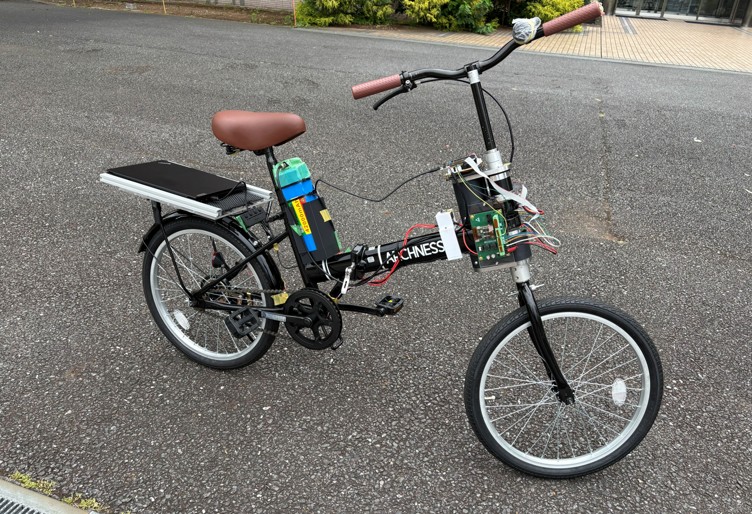
Title: Steer-by-Wire Experimental Bicycle
Caption: The steer-by-wire bicycle platform developed in this study uses haptic feedback and a machine-learning-based control framework to estimate rider intent and distinguish intentional turning maneuvers from unintended instability. By recognizing riding conditions in real time, it provides stabilization support only when necessary, helping improve safety while preserving natural vehicle handling.
Credit: Associate Professor Hiroaki Kuwahara from Shibaura Institute of Technology, Japan
Source Link: Not applicable
License Type: Original content
Usage restrictions: Cannot be used without permission.
Media Contact: Kohei Tsuchiya
E-mail: koho@ow.shibaura-it.ac.jp