Scientists Devise New Method for Tracing Environmental PFAS Contamination Better
2026/07/01
- Research
The new approach uses high-resolution Orbitrap mass spectrometry to enable stable carbon isotope analysis of PFAS contaminants found in the environment
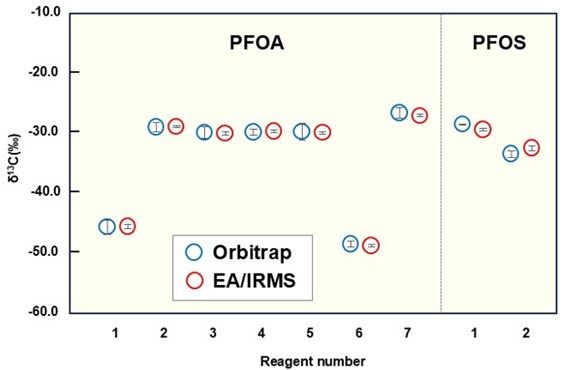
Title: Comparison of carbon isotope ratios of PFOA and PFOS measured using Orbitrap and EA-IRMS.
Caption: The figure shows δ¹³C values of perfluorooctanoic acid (PFOA) and perfluorooctanesulfonic acid (PFOS) measured using Orbitrap high-resolution mass spectrometry and elemental analyzer–isotope ratio mass spectrometry (EA-IRMS). The close agreement between the two methods demonstrates that Orbitrap-based analysis can reliably determine stable carbon isotope ratios of PFAS compounds, which may help researchers trace the sources of PFAS pollution in the environment.
Credit: Professor Hiroto Kawashima from Shibaura Institute of Technology, Japan
License Type: Original content
Usage restrictions: Cannot be reused without permission.
Perfluoroalkyl and polyfluoroalkyl substances (PFAS) are a class of synthetic chemicals widely used in industrial processes and consumer products because of their resistance to heat, water, and oil. However, these same properties also make them highly resistant to environmental degradation. As a result, PFAS, such as perfluorooctanesulfonic acid (PFOS) and perfluorooctanoic acid (PFOA), have been detected in various environmental matrices, including soil, drinking water, and the atmosphere. Identifying the sources of these contaminants is an important step toward understanding and managing PFAS pollution. One such approach for identifying pollution sources is stable isotope analysis, a technique that measures small variations in the ratios of naturally occurring isotopes within chemical compounds. However, applying this technique to non-volatile PFAS compounds, such as PFOS and PFOA, has remained a challenge.
In a recent study led by Professor Hiroto Kawashima from the Department of Bioscience and Engineering at Shibaura Institute of Technology (SIT), Japan, researchers investigated whether Orbitrap high-resolution mass spectrometry could be used to measure the stable carbon isotope ratios (δ¹³C) of PFAS compounds. Joining him in this collaboration were Tomoha Iezumi, a student from the Department of Bioscience and Engineering at SIT, and Momoka Suto and Dr. Sachi Taniyasu from the National Institute of Advanced Industrial Science and Technology, Japan. Their findings were published in Environmental Science & Technology Letters on March 03, 2026.
Explaining the motivation behind the work, Prof. Kawashima says, “PFAS contamination has become a serious environmental issue worldwide, but identifying their sources remains challenging. We were interested in whether high-resolution mass spectrometry, such as Orbitrap, could be used for stable isotope analysis to address this challenge.”
Traditionally, compound-specific isotope analysis relies on isotope ratio mass spectrometry (IRMS), which often requires chemical conversion steps such as combustion before isotope ratios can be measured. These additional procedures can complicate analysis, particularly for chemically stable compounds such as PFAS. To address this limitation, the researchers explored whether Orbitrap mass spectrometry, known for its extremely high mass resolution and accuracy, could directly measure isotopic variations in PFAS molecules. Describing the key advance of the study, Prof. Kawashima explains, “This study demonstrates a new analytical approach to measure the stable carbon isotope ratios of PFAS compounds such as PFOA and PFOS using Orbitrap mass spectrometry. The method enables high-precision isotope analysis without the need for conventional isotope ratio mass spectrometry. This opens a new pathway for identifying the sources and environmental behavior of PFAS contamination.”
To test the method, the researchers analyzed standard samples of PFOS and PFOA using Orbitrap mass spectrometry and compared the results with measurements obtained using elemental analysis–IRMS (EA-IRMS), a widely used reference method. The Orbitrap instrument detects molecular variants known as isotopologues, which differ slightly in mass depending on their isotopic composition. The results showed that the isotope ratios obtained using Orbitrap measurements closely matched those measured by EA-IRMS. The differences between the two methods were no more than ±2.0‰ (per mile), indicating that the Orbitrap-based approach can provide reliable compound-specific isotope data. Importantly, the method allows isotope measurements without the combustion steps typically required in conventional isotope ratio analysis.
The researchers also evaluated whether the technique could work in real water samples. For this purpose, they analyzed three river water samples spiked with PFAS compounds at nanomolar concentrations. The Orbitrap system successfully measured the isotopic signatures of the compounds in these samples, suggesting that the approach could potentially be used in environmental monitoring studies.
“One important application is identifying the sources of PFAS contamination in rivers, groundwater, and drinking water. By analyzing isotope signatures, it could help distinguish between different industrial sources of PFAS pollution,” says Prof. Kawashima, highlighting the practical implications of their work.
Overall, this study represents a step toward developing new analytical tools for tracing PFAS pollution in the environment. By demonstrating that Orbitrap mass spectrometry can measure the stable carbon isotope ratios of PFAS compounds, such as PFOS and PFOA, the findings open new possibilities for investigating the sources and environmental behavior of these persistent contaminants.
Method of Research: Experimental study
Subject of Research: Not applicable
Conflicts of Interest Statement: The authors declare no competing financial interests.
Website: https://www.shibaura-it.ac.jp/en/
Web: https://www.shibaura-it.ac.jp/en/
Perfluoroalkyl and polyfluoroalkyl substances (PFAS) are persistent environmental contaminants whose sources can be difficult to identify using standard analysis techniques. In a recent study, scientists demonstrated that Orbitrap high-resolution mass spectrometry can measure the stable carbon isotope ratios of PFAS compounds, such as perfluorooctanesulfonic acid and perfluorooctanoic acid. This analytical approach provides a promising tool for tracing PFAS pollution and improving understanding of the environmental behavior of these widely distributed fluorinated compounds.
Title: Comparison of carbon isotope ratios of PFOA and PFOS measured using Orbitrap and EA-IRMS.
Caption: The figure shows δ¹³C values of perfluorooctanoic acid (PFOA) and perfluorooctanesulfonic acid (PFOS) measured using Orbitrap high-resolution mass spectrometry and elemental analyzer–isotope ratio mass spectrometry (EA-IRMS). The close agreement between the two methods demonstrates that Orbitrap-based analysis can reliably determine stable carbon isotope ratios of PFAS compounds, which may help researchers trace the sources of PFAS pollution in the environment.
Credit: Professor Hiroto Kawashima from Shibaura Institute of Technology, Japan
License Type: Original content
Usage restrictions: Cannot be reused without permission.
Perfluoroalkyl and polyfluoroalkyl substances (PFAS) are a class of synthetic chemicals widely used in industrial processes and consumer products because of their resistance to heat, water, and oil. However, these same properties also make them highly resistant to environmental degradation. As a result, PFAS, such as perfluorooctanesulfonic acid (PFOS) and perfluorooctanoic acid (PFOA), have been detected in various environmental matrices, including soil, drinking water, and the atmosphere. Identifying the sources of these contaminants is an important step toward understanding and managing PFAS pollution. One such approach for identifying pollution sources is stable isotope analysis, a technique that measures small variations in the ratios of naturally occurring isotopes within chemical compounds. However, applying this technique to non-volatile PFAS compounds, such as PFOS and PFOA, has remained a challenge.
In a recent study led by Professor Hiroto Kawashima from the Department of Bioscience and Engineering at Shibaura Institute of Technology (SIT), Japan, researchers investigated whether Orbitrap high-resolution mass spectrometry could be used to measure the stable carbon isotope ratios (δ¹³C) of PFAS compounds. Joining him in this collaboration were Tomoha Iezumi, a student from the Department of Bioscience and Engineering at SIT, and Momoka Suto and Dr. Sachi Taniyasu from the National Institute of Advanced Industrial Science and Technology, Japan. Their findings were published in Environmental Science & Technology Letters on March 03, 2026.
Explaining the motivation behind the work, Prof. Kawashima says, “PFAS contamination has become a serious environmental issue worldwide, but identifying their sources remains challenging. We were interested in whether high-resolution mass spectrometry, such as Orbitrap, could be used for stable isotope analysis to address this challenge.”
Traditionally, compound-specific isotope analysis relies on isotope ratio mass spectrometry (IRMS), which often requires chemical conversion steps such as combustion before isotope ratios can be measured. These additional procedures can complicate analysis, particularly for chemically stable compounds such as PFAS. To address this limitation, the researchers explored whether Orbitrap mass spectrometry, known for its extremely high mass resolution and accuracy, could directly measure isotopic variations in PFAS molecules. Describing the key advance of the study, Prof. Kawashima explains, “This study demonstrates a new analytical approach to measure the stable carbon isotope ratios of PFAS compounds such as PFOA and PFOS using Orbitrap mass spectrometry. The method enables high-precision isotope analysis without the need for conventional isotope ratio mass spectrometry. This opens a new pathway for identifying the sources and environmental behavior of PFAS contamination.”
To test the method, the researchers analyzed standard samples of PFOS and PFOA using Orbitrap mass spectrometry and compared the results with measurements obtained using elemental analysis–IRMS (EA-IRMS), a widely used reference method. The Orbitrap instrument detects molecular variants known as isotopologues, which differ slightly in mass depending on their isotopic composition. The results showed that the isotope ratios obtained using Orbitrap measurements closely matched those measured by EA-IRMS. The differences between the two methods were no more than ±2.0‰ (per mile), indicating that the Orbitrap-based approach can provide reliable compound-specific isotope data. Importantly, the method allows isotope measurements without the combustion steps typically required in conventional isotope ratio analysis.
The researchers also evaluated whether the technique could work in real water samples. For this purpose, they analyzed three river water samples spiked with PFAS compounds at nanomolar concentrations. The Orbitrap system successfully measured the isotopic signatures of the compounds in these samples, suggesting that the approach could potentially be used in environmental monitoring studies.
“One important application is identifying the sources of PFAS contamination in rivers, groundwater, and drinking water. By analyzing isotope signatures, it could help distinguish between different industrial sources of PFAS pollution,” says Prof. Kawashima, highlighting the practical implications of their work.
Overall, this study represents a step toward developing new analytical tools for tracing PFAS pollution in the environment. By demonstrating that Orbitrap mass spectrometry can measure the stable carbon isotope ratios of PFAS compounds, such as PFOS and PFOA, the findings open new possibilities for investigating the sources and environmental behavior of these persistent contaminants.
Reference
Title of original paper:
Stable Carbon Isotope Analysis of PFOA and PFOS Using Orbitrap Mass SpectrometryJournal:
Environmental Science & Technology LettersDOI:
10.1021/acs.estlett.6c00075Additional information for EurekAlert
Latest Article Publication Date: 03 March 2026Method of Research: Experimental study
Subject of Research: Not applicable
Conflicts of Interest Statement: The authors declare no competing financial interests.
About Shibaura Institute of Technology (SIT), Japan
Shibaura Institute of Technology (SIT) is a private university with campuses in Tokyo and Saitama. Since the establishment of its predecessor, Tokyo Higher School of Industry and Commerce, in 1927, it has maintained “learning through practice” as its philosophy in the education of engineers. SIT was the only private science and engineering university selected for the Top Global University Project sponsored by the Ministry of Education, Culture, Sports, Science and Technology and had received support from the ministry for 10 years starting from the 2014 academic year. Its motto, “Nurturing engineers who learn from society and contribute to society,” reflects its mission of fostering scientists and engineers who can contribute to the sustainable growth of the world by exposing their over 9,500 students to culturally diverse environments, where they learn to cope, collaborate, and relate with fellow students from around the world.Website: https://www.shibaura-it.ac.jp/en/
About Professor Hiroto Kawashima from SIT, Japan
Dr. Hiroto Kawashima is a Professor in the Department of Bioscience and Engineering at the College of Systems Engineering and Science, Shibaura Institute of Technology, Japan, and collaborates with the National Institute of Advanced Industrial Science and Technology. He earned his Ph.D. from Yokohama National University and has over 20 years of research experience in environmental and analytical chemistry. His research focuses on stable isotope analysis and pollutant source identification using mass spectrometry. He has authored 45 papers with 728 citations to his credit and received the Best Poster Award from the Japan Society for Atmospheric Environment in September 2022.Funding Information
This work was supported by the Environmental Research and Technology Development Fund (5MF-2403) of the Environmental Restoration and Conservation Agency of Japan (ERCA) and a Grant-in-Aid for Scientific Research (A) (No. 21H04929) from the Ministry of Education, Culture, Sports, Science and Technology (MEXT), Japan.Media Contact: Kohei Tsuchiya
E-mail: koho@ow.shibaura-it.ac.jpWeb: https://www.shibaura-it.ac.jp/en/