New Low-Cost Tool Reveals Hidden Molecular Switch Points Under Light
- Research
A Shibaura Institute of Technology researcher has developed a quantum chemistry method to predict the behavior of molecules under light
Conical intersections are crucial molecular switching points in light-driven reactions, but accurately predicting them usually requires computations. A researcher from Shibaura Institute of Technology has developed a new low-cost quantum chemistry method that can simultaneously describe ground and excited molecular states while efficiently locating these elusive structures. The approach reproduces benchmark geometries with strong accuracy and enables practical simulations of photochemical processes, making it promising for applications in photocatalysis, solar cells, and biological light-response studies.
Light-driven molecular reactions are essential to many technologies and natural processes, from solar energy conversion and photocatalysis to vision and DNA repair. After absorbing light, molecules can rapidly rearrange their electrons and change chemical pathways within trillionths of a second. These transformations often pass through conical intersections, special points where two electronic states meet and molecules can switch states almost instantly. Although these intersections are central to photochemistry, accurately predicting them has traditionally required computationally expensive methods, limiting routine studies of larger and more realistic molecular systems.
Professor Takashi Tsuchimochi of the College of Engineering, Shibaura Institute of Technology, Koto-ku, Tokyo, Japan, has proposed a new solution to this challenge. He has developed a low-cost quantum chemistry method that can simultaneously describe stable ground states and unstable excited states of molecules while efficiently locating conical intersections. By redesigning one of the simplest excited-state theories, the researcher created a practical framework for exploring difficult reaction pathways with much lower computational cost than conventional approaches. The study was published online on April 21, 2026, in the Journal of Chemical Theory and Computation.
The new method extends configuration interaction singles, a widely known but limited theoretical model that has long been considered unable to treat conical intersections reliably. The approach enables molecules to change structure smoothly even in regions where electronic states nearly overlap. This allows researchers to optimize molecular geometries, trace excited-state pathways, and identify crossing points that standard low-cost methods often fail to capture. It also improves numerical stability during optimization steps. This makes repeated calculations more dependable for complex molecules and demanding reaction pathway scans across larger systems, routinely.
“Our motivation came from a long-standing challenge in computational photochemistry,” said Prof. Tsuchimochi. “Highly accurate methods exist, but they are often too expensive for realistic applications. We wanted a simpler approach that still captures the essential physics of conical intersections.”
Extensive benchmark tests demonstrated the effectiveness of the approach. In simulations of twelve minimum-energy conical intersections and the classic ethylene benchmark system, the method reproduced key molecular geometries with strong agreement to established high-level reference calculations. It also successfully captured the characteristic topology of conical intersections that conventional approaches miss. These results suggest that reliable excited-state reaction analysis can be achieved without the heavy computational burden normally associated with multireference quantum chemistry.
Prof. Tsuchimochi emphasized the broader significance of these findings. “Our goal is to make advanced excited-state simulations accessible for larger and more complex systems,” he said. “That could accelerate the discovery of next-generation materials and deepen our understanding of how molecules behave under light.”
Overall, the study highlights wide-ranging scientific and industrial relevance. In photocatalysis and light-driven synthesis, the method can help explain how absorbed light initiates chemical transformations. In materials science, it can support the design of solar cells, organic light-emitting diodes, and other light-responsive devices. In biology and medicine, it may improve understanding of DNA damage, repair pathways, and related photochemical effects. By reducing computational cost while maintaining reliable performance, the new method addresses a long-standing bottleneck in predictive molecular design.
Reference
|
Title of original paper: |
Analytical Nuclear Gradients for State-Averaged Configuration Interaction Singles Variants: Application to Conical Intersections |
|
Journal: |
Journal of Chemical Theory and Computation |
|
DOI: |
Additional information for EurekAlert
|
Latest Article Publication Date: |
21 April 2026 |
| Method of Research: |
Computational simulation/modeling |
| Subject of Research: Animals | Not Applicable |
| Conflicts of Interest Statement: | The author declares no competing financial interest |
Authors
About Shibaura Institute of Technology (SIT), Japan
Shibaura Institute of Technology (SIT) is a private university with campuses in Tokyo and Saitama. Since the establishment of its predecessor, Tokyo Higher School of Industry and Commerce, in 1927, it has maintained “learning through practice” as its philosophy in the education of engineers. SIT was the only private science and engineering university selected for the Top Global University Project sponsored by the Ministry of Education, Culture, Sports, Science and Technology and had received support from the ministry for 10 years starting from the 2014 academic year. Its motto, “Nurturing engineers who learn from society and contribute to society,” reflects its mission of fostering scientists and engineers who can contribute to the sustainable growth of the world by exposing their over 9,500 students to culturally diverse environments, where they learn to cope, collaborate, and relate with fellow students from around the world.
Website: https://www.shibaura-it.ac.jp/en/
About Professor Takashi Tsuchimochi from Shibaura Institute of Technology, Japan
Prof. Takashi Tsuchimochi is a Professor at the College of Engineering, Shibaura Institute of Technology, Koto-ku, Tokyo, Japan. He is also a Visiting Professor at the Institute of Molecular Science, Okazaki, Japan, and a FOREST researcher of the Japan Science and Technology Agency. He earned his PhD from Rice University in 2012. His research interests include quantum chemistry, theoretical chemistry, and computational chemistry. He has published 42 peer-reviewed articles, received over 5156 citations, and currently holds an h-index of 21, focusing on electronic structure methods, excited states, photochemistry, molecular dynamics, algorithm development, education, collaboration, and mentoring students worldwide through impactful research and teaching leadership today.
Funding Information
This work was supported by the JST FOREST Program, Grant No. JPMJFR223U, and JSPS KAKENHI, Grant No. 25K01733 and 25K22247.
image
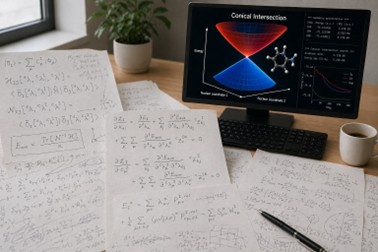
Title: Computational mapping of conical intersections in light-driven molecular reactions and benchmark simulation of ethylene energy surfaces
Caption: A researcher from Shibaura Institute of Technology, Japan, developed a low-cost quantum chemistry method that accurately predicts conical intersections, helping simulate light-driven molecular reactions for energy, materials, and biological applications.
Credit: Prof. Takashi Tsuchimochi from SIT, Japan
Source Link: NA
License Type: Original content
Usage restrictions: Cannot be used without permission
Media Contact: Kohei Tsuchiya
E-mail: koho@ow.shibaura-it.ac.jp