Millimeter-Scale Resolution in Fiber-Optic Sensing: Single-Ended Technique Advances Infrastructure Monitoring
- Research
Researchers demonstrate that overcoming signal distortions enables record-breaking spatial resolution in single-access distributed fiber-optic sensing
Distributed fiber-optic sensors are widely used to monitor temperature and strain in infrastructure, but their spatial resolution has long been limited. In a new study, researchers from Shibaura Institute of Technology and Yokohama National University, Japan, have demonstrated that operating near a previously avoided frequency regime and suppressing signal distortions allows reflection-based sensing to achieve a world-record spatial resolution of 6 mm among single-end-access configurations. This enables precise monitoring of temperature and strain in infrastructure.
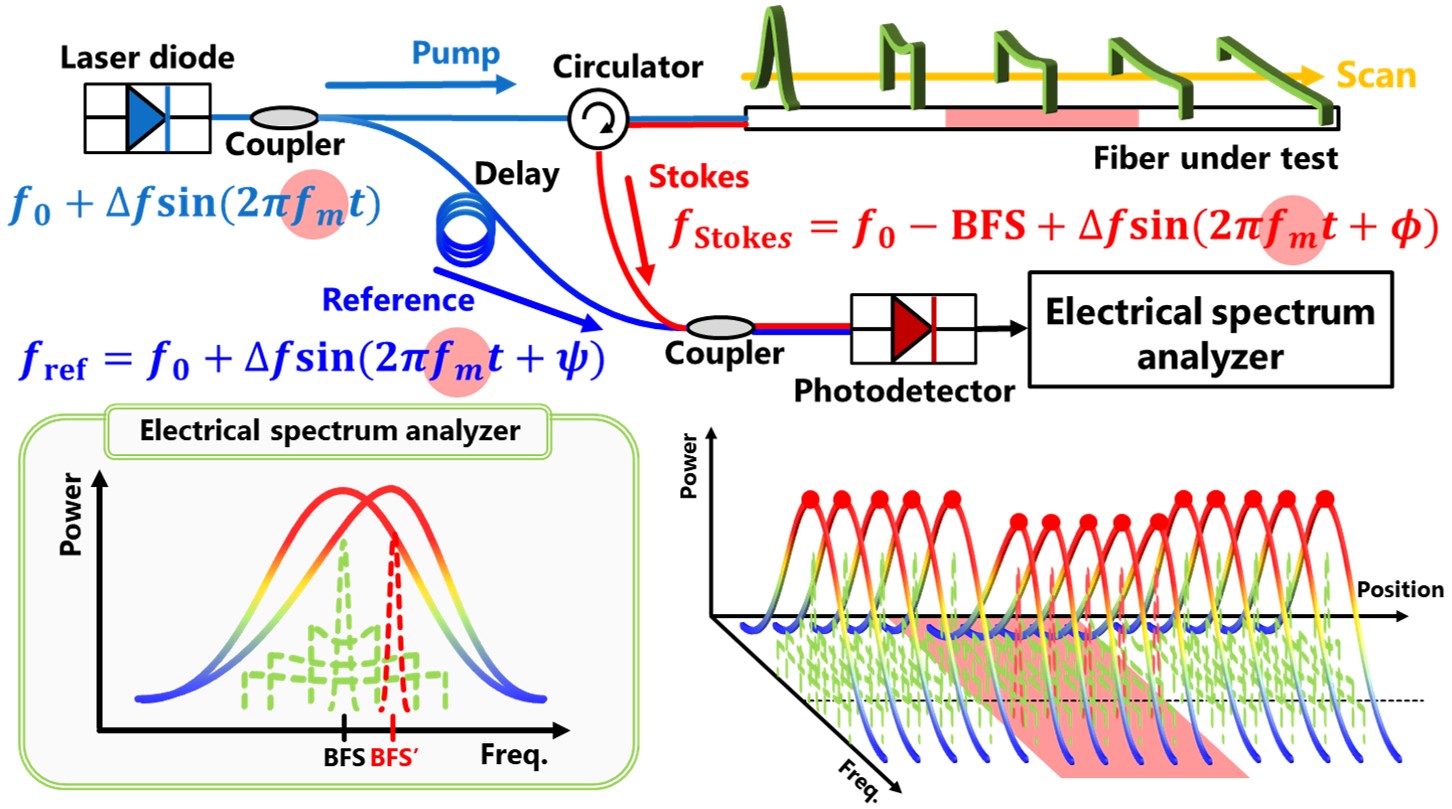 Title: Conceptual configuration and operating principle of Brillouin optical correlation-domain reflectometry (BOCDR)
Caption: Researchers demonstrate that operating at modulation frequencies close to Brillouin bandwidth and suppressing signal distortions allows BOCDR to achieve a world-record spatial resolution of 6 mm.
Credit: Prof. Yosuke Mizuno from Yokohama National University, Japan
Source Link:https://ieeexplore.ieee.org/document/11278604
License Type: CC BY 4.0
Usage restrictions: Credit must be given to the creator.
Distributed fiber-optic sensing technologies play a crucial role in monitoring temperature and strain across large structures such as bridges, tunnels, pipelines, and buildings. Unlike conventional point sensors, distributed fiber-optic sensors provide continuous measurements along their entire length, allowing early detection of damage or abnormal conditions. However, one persistent challenge has been spatial resolution—the ability to pinpoint exactly where a change occurs. Improving resolution without complicating system design has remained a central goal in fiber-optic sensing research.
One promising technique, known as Brillouin optical correlation-domain reflectometry (BOCDR), enables distributed sensing using light injected from only one end of the fiber. This reflection-based configuration simplifies installation and allows measurements even if the fiber is damaged. BOCDR also offers higher spatial resolution than many other Brillouin-based methods. Yet, its performance has been constrained by a widely accepted assumption: operating near or beyond the Brillouin bandwidth, a frequency range intrinsic to the fiber, was believed to cause unstable signals and unreliable measurements. As a result, this operating regime has largely been avoided, limiting achievable resolution.
In a new study, a team of researchers led by Prof. Heeyoung Lee from Shibaura Institute of Technology, Japan, along with Prof. Yosuke Mizuno from Yokohama National University, Japan, and Mr. Keita Kikuchi from Shibaura Institute of Technology, Japan, experimentally investigated BOCDR operation at modulation frequencies close to the Brillouin bandwidth. Their findings were published in the Journal of Lightwave Technology on April 1, 2026.
“To verify whether the Brillouin bandwidth limitation was truly fundamental or simply not well understood, we examined the origin of the signal distortions and explored ways to control them. Notably, we discovered that this forbidden operating region can be used to significantly enhance spatial resolution,” says Prof. Lee.
The researchers observed that at higher modulation frequencies, periodic distortions appeared in the Brillouin gain spectrum, interfering with the accurate extraction of temperature and strain information. These distortions degrade the linear relationship between temperature/strain and the Brillouin frequency shift, particularly at high spatial resolution.
Rather than treating these distortions as unavoidable, the team carefully analyzed their physical origin and developed a signal-processing method to suppress them. By mapping the measured spectra into the frequency domain and selectively removing the modulation-induced components, they restored the stability and linearity of the Brillouin signal. This approach allowed BOCDR to operate reliably in a frequency regime that had previously been considered impractical.
Using this strategy, the researchers achieved distributed temperature and strain measurements with a spatial resolution of 6 mm—the highest ever reported for single-ended Brillouin sensing. In experimental demonstrations, the system successfully detected temperature changes confined to millimeter-scale fiber sections and resolved abrupt strain-like transitions introduced by short fiber segments with different optical properties.
The implications of this work extend beyond laboratory demonstrations. Aging infrastructure and increasing exposure to natural disasters demand sensing technologies capable of detecting subtle, highly localized changes before they escalate into serious damage to public safety and maintenance efficiency. Achieving millimeter-scale resolution using a simple, single-end-access fiber configuration makes practical deployment of fiber-optic sensors more feasible across civil engineering, energy, transportation, and robotics-related industries.
“Our study addresses the limitations of conventional sensors that miss the detection of subtle changes and proposes an approach that can be used for monitoring the integrity of optical waveguides, sensing the shape of flexible structures, and future robotic systems,” says Prof. Lee.
By overcoming a long-standing performance barrier, this study opens new pathways for distributed sensing systems that function like a “nerve network,” continuously monitoring the health of critical structures.
Reference
|
Title of original paper: |
BOCDR achieving 6-mm spatial resolution at modulation frequencies close to Brillouin bandwidth |
|
Journal: |
Journal of Lightwave Technology |
|
DOI: |
Authors
About Professor Heeyoung Lee from SIT, Japan
Dr. Heeyoung Lee is a Professor at the Graduate School of Engineering and Science, Shibaura Institute of Technology, Japan. She received a Ph.D. in Electrical and Electronic Engineering from the Institute of Science Tokyo, Japan, in 2019. Her research interests include fiber-optic sensing, polymer optics, and optoelectronics. She has been honored with multiple awards, including the NF Foundation R&D Encouragement Award 2019, the Kashiko Kodate Promotion and Nurturing of Female Researchers Contribution Award 2021, and the SCAT President’s Award 2025.
Funding Information
This work was supported in part by JSPS KAKENHI under Grant 21H04555 and Grant 22K14272 and by research grants from the Telecommunications Advancement Foundation, and in part by Asahipen Hikari Foundation.