Vote3D-AD: A Novel Framework for Unsupervised Point Cloud Anomaly Localization

2026/02/25
  • Research

The proposed technology leverages varied defect synthesis and differentiable vote clustering to achieve remarkable performance 

Current 3D anomaly detection techniques often prove insufficient for noisy industrial scans. In a new study, researchers from Shibaura Institute of Technology, Japan, and FPT University, Vietnam, have developed Vote3D-AD as an innovative solution. The single-pass framework trains exclusively on defect-free data and utilizes the Varied Defect Synthesis pseudo-anomaly generator and a vote-and-cluster architecture to outperform state-of-the-art alternatives on various benchmarks. It is expected to further streamline inspection pipelines. 

The automatic detection of surface-level irregularities—defects or anomalies—in 3D data is of significant interest for various real-world purposes, such as industrial quality inspection, infrastructure monitoring, robotics, and autonomous systems. However, collecting annotated defect examples at a large scale is costly, and existing 3D anomaly detection methods either require templates or heavy memory, multiple inference passes, and brittle heuristic clustering. These shortcomings limit real-life deployment.

In a novel research work, a team of researchers from Japan and Vietnam, led by Associate Professor Phan Xuan Tan, affiliated with the Innovative Global Program, College of Engineering, Shibaura Institute of Technology, Japan, and including Dr. Dinh-Cuong Hoang from FPT University, Vietnam, has proposed Vote3D-AD as a new single-pass framework for 3D anomaly localization. Their novel findings were made available online on January 20, 2026, and have been published in Volume 137 of the Alexandria Engineering Journal  on February 1, 2026.

Vote3D-AD combines a realistic pseudo-anomaly generator (Varied Defect Synthesis, or VDS), with a learned vote-and-differentiable clustering architecture to localize defects in point clouds, while training only on defect-free data. It demonstrates stronger and more reliable localization than prior works. Across both synthetic and real industrial benchmarks, Vote3D-AD improves point-level AUROC by ~6.7%, and point-AUPR by ~10.1%, and point-F1 by ~11.2% over the strongest baselines. Notably, object-level metrics also rise substantially.

The proposed framework exhibits practical speed for real inspection pipelines. The full pipeline runs at approximately 9.05 FPS on an RTX-3090 and supports higher-throughput variants, demonstrating a balance of high accuracy and practical inference speed for production inspection. Vote3D-AD turns sparse, noisy point-level signals into coherent region proposals without hand-tuned clustering, reducing the engineering burden and improving localization precision, which is critical for making automated 3D inspection actionable on factory floors.

Its real-world applications include automated industrial quality inspection of sheet metal, machined parts, and plastic housings, where it detects dents, bulges, holes, missing components, and surface roughness from depth scans, especially in situations where RGB or 2D images miss geometric faults. Vote3D-AD is also expected to be useful for infrastructure and asset monitoring. It can localize cracks, holes, and surface degradation in scanned components, such as pipes, panels, and connectors, where early geometric anomalies predict failure. Moreover, it may enable robots to verify assembly quality or to detect damage on manipulated objects using onboard depth sensors, even when only defect-free examples are available during training. Furthermore, the framework can combine multi-view or streamed point clouds to detect thermal or structural anomalies—with potential future multi-modal fusion—improving predictive maintenance decisions.

According to Dr. Tan, “Tighter and more coherent anomaly masks present in Vote3D-AD—thanks to learned clustering and boundary refinement—reduce false alarms and ambiguous detections, lowering unneeded rework and downtime in manufacturing lines. In addition, since Vote3D-AD trains on normal examples only and uses learned vote clustering instead of template matching or big feature stores, it is easier to deploy across different product families and manufacturers. This reduces engineering and data collection costs.”
 
“Furthermore, our technology utilizes VDS that generates diverse, physically plausible pseudo-defects such as bulges, dents, holes, cracks, and surface roughness, and simulates sensor artifacts such as noise and dropout, which substantially narrows the gap between simulated training signals and real defects, improving generalization,” highlights Dr. Tan.
 
Lastly, by producing coherent region proposals rather than scattered point outliers, the proposed system supports downstream actions such as automatic rejection, targeted repair, and prioritization for human review, making inspection pipelines more efficient and safer.

Reference

Title of original paper:

Vote3D-AD: Unsupervised point cloud anomaly localization via varied defect synthesis and differentiable vote-clustering 

Journal:

Alexandria Engineering Journal

DOI:

https://doi.org/10.1016/j.aej.2026.01.024 

Additional infotmation for EurekAlert

Latest Article Publication Date: 1 February 2026
Method of Research:

Computational simulation/modeling 

Subject of Research: Not Applicable 
Conflicts of Interest Statement: The authors declare that they have no known competing financial interests or personal relationships that could have appeared to influence the work reported in this paper.
 

Authors

About Shibaura Institute of Technology (SIT), Japan

Shibaura Institute of Technology (SIT) is a private university with campuses in Tokyo and Saitama. Since the establishment of its predecessor, Tokyo Higher School of Industry and Commerce, in 1927, it has maintained “learning through practice” as its philosophy in the education of engineers. SIT was the only private science and engineering university selected for the Top Global University Project sponsored by the Ministry of Education, Culture, Sports, Science and Technology and had received support from the ministry for 10 years starting from the 2014 academic year. Its motto, “Nurturing engineers who learn from society and contribute to society,” reflects its mission of fostering scientists and engineers who can contribute to the sustainable growth of the world by exposing their over 9,500 students to culturally diverse environments, where they learn to cope, collaborate, and relate with fellow students from around the world.

Website: https://www.shibaura-it.ac.jp/en/

About Associate Professor Phan Xuan Tan from SIT, Japan

Dr. Phan Xuan Tan is an Associate Professor in the Innovative Global Program, College of Engineering, Shibaura Institute of Technology (SIT), Japan. He earned a B.E. in Electrical–Electronic Engineering from Le Quy Don Technical University and an M.S. in Computer and Communication Engineering from Hanoi University of Science and Technology, Vietnam. He received his Ph.D. in Functional Control Systems from SIT in 2018. His academic work bridges engineering and artificial intelligence, with research centered on computer vision, image processing, generative AI, and AI safety.


Image
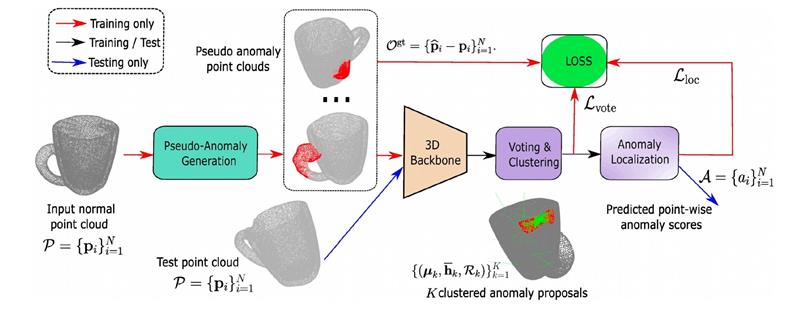
 
20260227_002

Title: Vote3D-AD framework
Caption: The proposed framework consists of Varied Defect Synthesis (VDS) pseudo-anomaly generator, transformer-based backbone, voting network, and differentiable clustering module, enabling precise point- and object-level anomaly scoring. 
Credit: Associate Professor Phan Xuan Tan from Shibaura Institute of Technology, Japan
Source Link: https://www.sciencedirect.com/science/article/pii/S1110016826000438 
License Type: CC BY 4.0
Usage restrictions: Credit must be given to the creator. 

 Media Contact: Kohei Tsuchiya
E-mail: koho@ow.shibaura-it.ac.jp  
Web: https://www.shibaura-it.ac.jp/en/