Novel Wireless Origami-Inspired Smart Cushioning Device for Safer Logistics
- Research
Researchers develop a new smart cushioning material that can wirelessly detect and provide information on damage to transported goods.
Smart cushioning materials with sensing features can enable real-time detection of damage to transport goods. However, current sensing technologies require wired connections for power and data transmission, limiting applicability. In a new study, researchers have developed a novel origami-inspired wireless, battery-free smart cushioning material that can accurately detect and provide measurement of damage to transported goods. This material holds strong potential for improving logistics and transport traceability.
Title: Working of the smart cushioning device
Caption: The proposed origami-inpsired smart cushioning device enables wirless, battery-free damage detection of transported goods, offering a practical solution for improving safety and traceability in logistics and transport.
Credit: Hiroki Shigemune from Shibaura Institute of Technology, Japan
Source Link: https://doi.org/10.1038/s41528-025-00527-z
License Type: tCC BY-NC-ND 4.0
Usage restrictions: Credit must be given to the creator. Only noncommercial uses of the work are permitted. No derivatives or adaptations of the work are permitted.
Origami, the traditional Japanese art of paper folding, has received considerable attention in engineering. By applying paper-folding principles, researchers have created compact structures that are flexible, lightweight, and reconfigurable across aerospace, medicine, and robotics. Moreover, origami-inspired designs have been explored at many scales, from microscopic structures such as DNA origami to large deployable systems for space applications. More recently, integrating electronics into origami structures has enabled the development of smart sensors that combine mechanical strength, flexibility, and energy absorption.
One promising application of smart origami electronics is in cushioning materials used for transporting goods. Integrating sensing features into cushioning materials could allow real-time monitoring of pressure, weight, or impact during shipping, improving traceability and reducing damage. Although a variety of sensing technologies have been examined for such “self-diagnosing” smart cushioning materials, these technologies rely on wired connections for power and data transfer. Making such systems wireless and battery-free could significantly reduce maintenance needs, simplify integration, and expand their use across diverse environments.
To achieve this goal, a research team led by Associate Professor Hiroki Shigemune, along with Mr. Hiroaki Minamide and Mr. Satoshi Motoyama from the Shibaura Institute of Technology in Japan, has developed an origami-inspired smart cushioning material capable of wirelessly monitoring deformation. “We have developed a self-folded origami honeycomb device, integrated with passive wireless inductor-capacitor (LC) sensors directly into the load-bearing structure,” explains Dr. Shigemune. “In this design, the mechanical deformation of the structure is transduced into a sensing signal.” Their study was published online in npj Flexible Electronics journal on January 09, 2026.
The proposed smart cushioning material, called a self-folded origami honeycomb device (SHD), is fabricated using a simple process. The honeycomb structure is formed by printing predefined patterns onto the paper, causing it to fold automatically into a three-dimensional structure composed of multiple cells connected by hinge-like joints. When external force is applied, these hinges buckle in a predictable manner, allowing the structure to absorb energy.
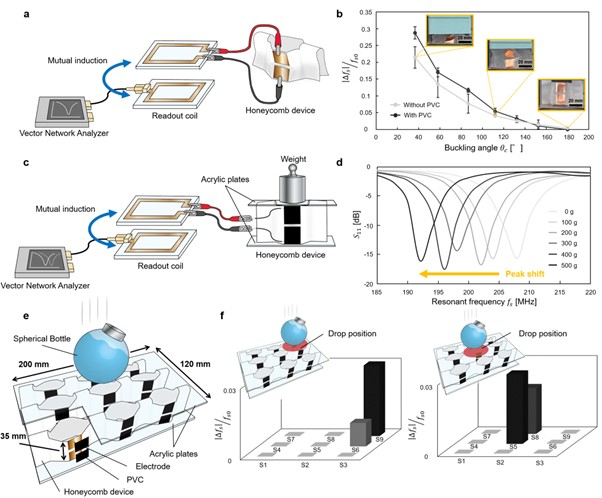
In the initial design, the researchers embedded both the inductor and capacitor within the SHD. Copper electrodes placed at the hinges formed capacitors, with the air gap between them acting as the dielectric. The inductor was positioned on the flat regions of the cells. During compression, the cells buckle, reducing the distance between the capacitor electrodes. This change shifts the resonant frequency of the LC circuit, which can be detected wirelessly using a readout coil and a vector network analyzer. However, because the inductor was also deformed during compression, its response introduced variability, which reduced measurement reproducibility.
To resolve this issue, the team created a new design where capacitor plates were embedded on the side wall of the cells within the SHD and connected to an external inductor. Using this improved design, they conducted compression tests on six different SHDs with varying capacitor electrode arrangements. By analyzing how the structures buckled under load, the team optimized the electrode placement for stability. The most stable configuration was found to have an electrode gap of 3 millimeters with an electrode gap angle of 0 degrees. To enhance sensitivity, they also applied a thick PVC tape to the electrode surface.
The final design was evaluated using finite element simulations and validated through experiments. Designs both with and without PVC tape showed close agreement between simulations and experiments. The researchers then demonstrated the practical usefulness of the device in two scenarios: measuring the weight of an applied load and detecting damage caused by a falling object. In both cases, the SHD successfully detected deformation wirelessly and provided accurate measurements, highlighting its potential for real-world use.
“Our smart cushioning device can be applied in the transportation and logistics industries to monitor load conditions, detect impact or damage, and improve traceability during shipping,” notes Dr. Shigemune. “It will be particularly valuable in agriculture, where delicate products require careful handling, but it can also benefit everyday delivery services by helping protect goods and ensure safer distribution.”
Overall, this origami-inspired smart cushioning material represents a scalable and maintenance-free approach to wireless damage detection, offering a practical solution for improving safety and traceability in logistics and transport.
Reference
|
Title of original paper: |
Smart cushioning device integrating self-folding origami honeycomb structure and inductor-capacitor passive wireless sensor |
|
Journal |
npj Flexible Electronics |
|
DOI: |
Authors
About Associate Professor Hiroki Shigemune from SIT, Japan
Dr. Hiroki Shigemune is an Associate Professor at the School of Engineering at Shibaura Institute of Technology (SIT), Japan. He is also associated with the International Research Center for Green Electronics at SIT. He received his B.S. and M.S. in Applied Physics, and Doctor of Engineering degrees in Modern Mechanical Engineering from Waseda University, Japan, in 2014, 2016, and 2018, respectively. His research interests include self-assembly systems, morphological computation, printing methods, and soft-bodied robotics. As the Director of the Active Functional Devices Lab, he has published over 90 research papers that have been cited more than 800 times.
Funding Information
This research was partially supported by JSPS KAKENHI Grant Numbers JP22K14226, Adaptable and Seamless Technology Transfer Program through Target-driven R&D (A-STEP) from the Japan Science and Technology Agency (JST) Grant Numbers JPMJTM20CK, Fuji Seal Foundation, and International Research Center for Green Electronics.