Precise, High-Energy-Focused Electron Beams Can Improve Polymer Strength
- Research
Researchers observe beneficial structural changes in polyethylene following exposure to high-energy-focused electron beam irradiation
Despite their widespread use in various applications, synthetic polymers such as polyethylene (PE) remain susceptible to structural deformation when exposed to stress. In a new study, scientists from Japan have utilized focused electron beam (FEB) irradiation to precisely induce microvoids and nanoscale fibrils to improve the mechanical strength of PE. Following irradiation with FEB, PE demonstrated minimal crack opening and prevented further crack propagation. This study can fuel the development of superior polymer-based materials.
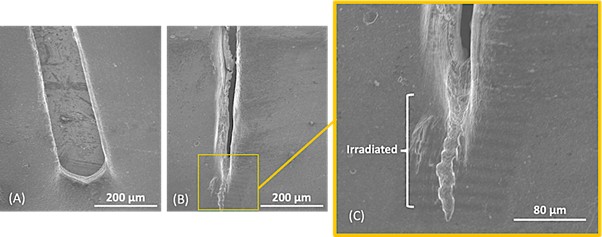
Title: Scanning electron microscopy images showing a wide crack opening (image A) in non-irradiated polyethylene (PE) and minimal crack propagation in PE irradiated with a focused electron beam
Advancements in fabrication technologies have revolutionized the field of materials science. In recent years, innovative materials for applications in electrical, energy storage, and catalysis have been developed. Among novel materials, polymers such as polyethylene (PE) are remarkable for their chemical inertness, lightweight nature, and flexibility. However, PE is increasingly susceptible to crack initiation and propagation—a process where a microcracks forms and spreads across the material surface when exposed to high stress—limiting its widespread use.
Scientists around the globe have employed crazing, a phenomenon where microvoids and fibrils are intentionally introduced into a material to improve the structural and mechanical properties of polymers. Several reports indicate that crazing can enhance the material properties of polymers while also preventing crack initiation and propagation. However, one major drawback limiting the use of conventional approaches to crazing is the lack of controllability.
In this light, a research team comprising Postdoctoral Fellow Dr. Sirorat Toocharoen and Professor Masayuki Shimojo, both from the Department of Materials Science and Engineering, Shibaura Institute of Technology, Japan, has utilized focused electron beam (FEB) irradiation to precisely control crazing in PE polymer. Additionally, they investigated the irradiation parameters that affect crazing and verified whether FEB irradiation can arrest crack propagation. Their research findings were published online in the journal Advanced Materials Technologies on July 24, 2025.
Explaining the motivation behind the present study, Dr. Toocharoen says, “It is well-known that polymers are inherently sensitive to electron beam exposure, even during conventional imaging techniques such as scanning electron microscopy (SEM). However, FEB irradiation has the ability to induce structural changes at micro- to nanoscale levels with high spatial precision. This realization led us to explore how FEB could be utilized not only as a diagnostic tool but also as a method for purposeful structural modification in polymers.”
Initially, the researchers observed structural changes in the PE polymer following FEB irradiation. SEM analysis further confirmed the presence of nanovoids and nanofibrils in PE, which were characteristic of crazing. Thereafter, they evaluated the effects of irradiation parameters such as accelerating voltage, beam current, and irradiation time on crazing. Through Monte Carlo simulations, they found that high-to-moderate energy FEB beams were ideal for inducing craze formation in deeper areas of PE, while lower-energy beams caused crazing close to the surface.
To further validate if crazing could arrest crack propagation, the scientists introduced pre-cracks into PE, followed by exposure to FEB irradiation. Post-irradiation tensile strength analysis revealed that the pre-crack widened considerably in non-irradiated PE. Remarkably, PE irradiated with FEB showed minimal crack opening and prevented crack propagation.
“The ability to precisely induce crazing and control crack-arrest behavior in PE demonstrates the strong potential of FEB for future applications,” comments Dr. Toocharoen. “Our findings are particularly relevant for industries requiring lightweight, flexible, and mechanically reliable polymer components in compact forms, such as flexible electronics, biomedical devices, aerospace, and micro/nanoelectromechanical systems. Moreover, this study provides valuable insights for nano-fabrication processes and is important for guiding further in-depth research in this area.”
In summary, this study demonstrates the advantages of using FEB irradiation for modifying the structural and mechanical properties of polymers. By enabling the precise control of inducing microvoids and fibrils, FEB can fuel the development of innovative materials with superior material properties.
Reference
|
Title of original paper: |
Nanomodification of Polyethylene via Focused Electron Beam Irradiation: Controlled Crazing and Application to Crack Arresting |
|
Journal: |
Advanced Materials Technologies |
|
DOI: |
Additional infotmation for EurekAlert
| Latest Article Publication Date: | 24 July 2025 |
| Method of Research: |
Experimental study |
| Subject of Research: | Not Applicable |
| Conflicts of Interest Statement: | The authors declare no conflict of interest. |
Authors
About Postdoctoral Fellow Sirorat Toocharoen from SIT, Japan
Dr. Sirorat Toocharoen is currently a Postdoctoral Fellow in the Department of Materials Science and Engineering at Shibaura Institute of Technology, Japan, where she has been a member of Professor Masayuki Shimojo’s laboratory since her doctoral studies. Her current research focuses on material characterization, nanotechnology, and the use of focused electron beam (FEB) irradiation for polymer and material modification. She has published several research papers in peer-reviewed journals on materials science and FEB-based nanomodification.
Funding Information
NA