Seeing the Unseen: Scientists Demonstrate Dual-Mode Color Generation from Invisible Light
- Research
Researchers from Japan develop an organic crystal that turns invisible light into visible red and green signals
Ultraviolet and near-infrared light are widely used in modern technologies but are invisible to the human eye. Researchers from Japan have developed an organic crystal that converts these invisible wavelengths into visible red and green light. Remarkably, the two colors arise from different physical processes coexisting within a single crystal. This dual-mode optical response provides a better understanding of molecular design and crystal packing, opening new possibilities for optical sensing and photonic technologies.
Invisible light beyond the range of human vision plays a vital role in communication technologies, medical diagnostics, and optical sensing. Ultraviolet and near-infrared wavelengths are routinely used in these fields, yet detecting them directly often requires complex instrumentation. Developing materials that can convert invisible light into visible signals could serve as essential components for measurement technologies and sensors, and play a major role in understanding the fundamental photophysical processes. However, developing those materials remains a key challenge in photonics and materials science.
Organic luminescent materials are attractive candidates for addressing this challenge because of their lightweight nature, chemical tunability, and structural flexibility. However, their optical efficiency is frequently limited by energy losses arising from molecular motion and nonradiative decay. To overcome these issues, researchers have focused on rigid molecular frameworks and controlled crystal packing, where intermolecular interactions can give rise to collective optical properties not observed in solution.
Against this backdrop, a team of researchers led by Prof. Akiko Hori from the Graduate School of Engineering and Science, Shibaura Institute of Technology (SIT), Japan, along with Prof. Ayumi Ishii from Waseda University, Japan, and Prof. Hiroko Yokota from the Institute of Science Tokyo, Japan, explored whether a single organic crystal could produce multiple optical responses to different forms of invisible light. This study was made available online on December 09, 2025, and published in Volume 62, Issue 6 of the journal Chemical Communications on January 22, 2026, and was featured on the journal’s front cover.
The team designed and synthesized a rigid, π-conjugated organic compound incorporating a 1,2,5-thiadiazole-substituted pyrazine unit and succeeded in growing high-quality single crystals. Although the crystal appears yellow under ambient conditions, its optical behavior proved highly unusual. When irradiated with ultraviolet light, the crystal emitted red light with an exceptionally large Stokes shift—the emitted light had much lower energy than the absorbed light. Detailed analysis revealed that this red emission originates from an excimer state formed through close intermolecular interactions within the crystal lattice.
Surprisingly, the same crystal displayed a second, entirely different optical response under near-infrared irradiation. When exposed to near-infrared radiation, it generated green visible light through second harmonic generation (SHG), a nonlinear optical process that converts two low-energy photons into a single higher-energy photon. Importantly, the two optical responses—red fluorescence from excimer formation and green light from SHG—coexisted within the same crystal without interfering with one another.
“What is remarkable about this crystal is that two fundamentally different physical phenomena operate independently within a single organic crystal,” explains Prof. Hori. “By carefully controlling molecular structure and crystal packing, we were able to visualize different kinds of invisible light using distinct optical mechanisms.”
The inspiration for this research arose from the team’s long-standing interest in how molecular arrangement influences optical behavior. “When we noticed that a yellow crystal emitted red light, it made us wonder whether other colors could also be produced,” says Prof. Hori. “That simple curiosity—sparked by everyday observations—motivated us to explore whether crystal packing and molecular arrangements could generate multiple optical responses.”
This dual-mode optical behavior has important implications for future technologies. Materials that convert ultraviolet and near-infrared light into visible signals could serve as key components in optical sensors, imaging systems, and measurement devices. Traditionally, optical wavelength conversion has relied on inorganic crystals, which are often heavy, rigid, and difficult to process. This study highlights that similar functions can be realized via molecular design and crystal packing in organic crystals.
By demonstrating comparable functionality in an organic crystal, this study broadens material design strategies for next-generation photonic devices, and highlights the untapped potential of molecular crystals for visualizing invisible light.
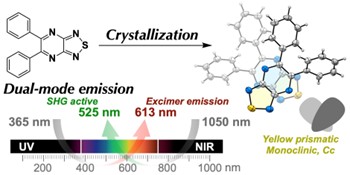
Title: Dual-mode emission from an organic crystal under ultraviolet and near-infrared light
Caption: Researchers from Japan showed that a single organic crystal converts invisible light into visible colors, emitting red light under ultraviolet irradiation and green light under near-infrared excitation through two distinct optical mechanisms.
Credit: Professor Akiko Hori from Shibaura Institute of Technology, Japan
Source Link: https://doi.org/10.1039/D5CC05735C
License Type: CC BY 3.0
Usage restrictions: Credit must be given to the creator.
Reference
|
Title of original paper: |
ll1,2,5-thiadiazole derivaRed-fluorescence under UV and green-SHG under NIR dual-mode emission in a yellow crystal of a 1,2,5-thiadiazole derivativetive |
|
Journal: |
Chemical Communications |
|
DOI: |
Additional infotmation for EurekAlert
| Latest Article Publication Date: |
January 22, 2026 |
| Method of Research: |
Experimental study; |
| Subject of Research: Animals | Not Applicable |
| Conflicts of Interest Statement: | There are no conflicts to declare. |
Authors
About Shibaura Institute of Technology (SIT), Japan
Shibaura Institute of Technology (SIT) is a private university with campuses in Tokyo and Saitama. Since the establishment of its predecessor, Tokyo Higher School of Industry and Commerce, in 1927, it has maintained “learning through practice” as its philosophy in the education of engineers. SIT was the only private science and engineering university selected for the Top Global University Project sponsored by the Ministry of Education, Culture, Sports, Science and Technology and had received support from the ministry for 10 years starting from the 2014 academic year. Its motto, “Nurturing engineers who learn from society and contribute to society,” reflects its mission of fostering scientists and engineers who can contribute to the sustainable growth of the world by exposing their over 9,500 students to culturally diverse environments, where they learn to cope, collaborate, and relate with fellow students from around the world.
Website: https://www.shibaura-it.ac.jp/en/
About Professor Akiko Hori from SIT, Japan
Dr. Akiko Hori is a Professor in the Department of Applied Chemistry at the Graduate School of Engineering and Science, Shibaura Institute of Technology (SIT), Japan. She heads the Laboratory of Molecular Assemblies. Her research focuses on supramolecular chemistry, materials chemistry, and inorganic chemistry, with a particular emphasis on crystal structures and molecular interactions. She possesses extensive expertise in coordination complexes, crystallography, molecular recognition, organic synthesis, and host–guest chemistry.
Funding Information
This work was supported by Grant-in-Aid for Scientific Research B, 23K21122, of JSPS KAKENHI and S-SPIRE project of Shibaura Institute of Technology (Akiko Hori). Hiroko Yokota acknowledges financial support for JPMJFR213Z of JST FOREST and Grant-in-Aid for Scientific Research B, 24K00554, of JSPS KAKENHI.
Media Contact: Kohei Tsuchiya
E-mail: koho@ow.shibaura-it.ac.jp
Web: https://www.shibaura-it.ac.jp/en/