Balancing Alkalinity and Strength in Construction Soil by Optimizing Aeration Timing
- Research
Stabilized construction-generated soil is often too alkaline for reuse, while neutralization depends on curing conditions. Although aeration curing is the cheapest way to lower alkalinity, there has been no guidance on when to begin it. Now, researchers from Shibaura Institute of Technology reveal that immediate aeration is preferable when neutralization is the priority, whereas a sealed period is useful when added strength is needed, providing a practical scheduling framework for soil-recycling operations.
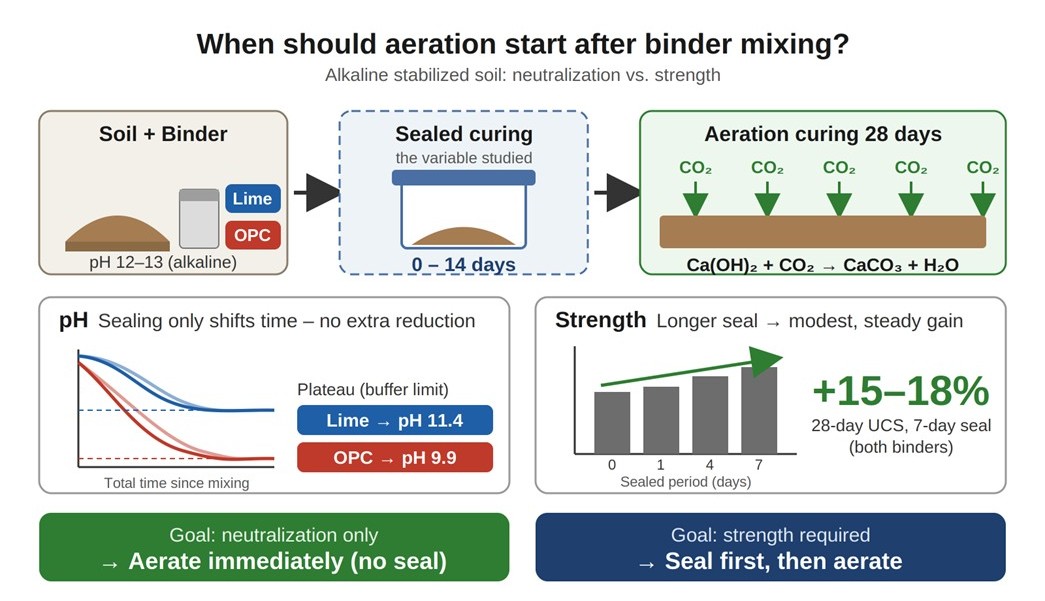
Title: Effect of sealed-curing duration on aeration curing of stabilized soil
Caption: Researchers propose a compact process-selection framework linking sealed duration, aeration duration, binder chemistry, and performance targets for reuse of construction-generated soil. It states that immediate aeration is preferred when neutralization is the main goal, whereas sealing before aeration can be used when greater strength is required.
Credit: Professor Shinya Inazumi from Shibaura Institute of Technology, Japan
Source Link: NA
License Type: Original content
Usage restrictions: Cannot be reused without permission.
Construction-generated soil is one of the largest by-product streams from construction, yet its reuse can be limited after stabilization with cement- or lime-based binders. These binders improve workability and strength but generate calcium hydroxide, raising pore-solution pH to strongly alkaline levels that can inhibit plant growth and threaten surrounding water quality. Aeration curing offers a low-cost route to reduce this alkalinity by exposing treated soil to atmospheric carbon dioxide, which converts calcium hydroxide into calcium carbonate. However, there is a lack of quantitative guidance on when aeration should begin after binder mixing.
To address this gap, a research team led by Professor Shinya Inazumi from the College of Engineering, Shibaura Institute of Technology, Japan, has examined whether the sealed-curing period between binder mixing and aeration changes subsequent neutralization and strength. The team compared two binders with contrasting reaction kinetics, a quicklime-rich lime-based binder, which generates most of its calcium hydroxide rapidly through slaking, and ordinary Portland cement (OPC), which releases calcium hydroxide progressively during hydration. This study was made available online on August 13, 2026, and will be published in Volume 32 of Results in Engineering on December 01, 2026.
“While construction-generated soil is produced in far larger volumes, its reuse rate lags due to the strong alkalinity, which inhibits plant growth and threatens water quality. The cheapest way to lower the alkalinity is aeration curing, however, there has been no quantitative basis for deciding when to begin it. Our study addresses this gap, providing quantitative guide for scheduling aeration curing,” says Prof. Inazumi.
The researchers prepared an adjusted mixed soil containing construction sludge and dewatered water-treatment sludge cake in a 2:1 volume ratio. The lime-based binder was added at 89.0 g/L and OPC at 95.0 g/L. After mixing, lime-treated samples were sealed for 0, 1, 3, 5, 7, and 14 days, while OPC-treated samples were sealed for 0, 1, 4, and 7 days. All samples were then aerated for 28 days. Soil-suspension pH was measured at 48-hour intervals, with a final measurement on day 28, and unconfined compressive strength (UCS) was measured using three specimens for each condition.
The two binder systems behaved differently during neutralization. For the quicklime-rich binder, the duration of sealing had essentially no effect on either the rate or magnitude of pH reduction, and all cases converged to a terminal pH of approximately 11.4. For OPC, longer sealing produced a faster pH decrease during the first few days of aeration. Yet when the pH data were re-plotted against total elapsed time since mixing, the different OPC cases collapsed onto the same trajectory and converged to a terminal pH of approximately 9.9. This showed that sealing did not add neutralizing capacity; it merely shifted part of the process in time.
In contrast, strength benefited from sealing. For both binders, 28-day UCS increased monotonically with sealed-curing duration. A 7-day seal increased UCS by approximately 15–18%. Within the tested 0–7-day range, the increase corresponded to an apparent gain of roughly 2% of the no-seal strength per additional sealed day, although the researchers caution that this preliminary relationship should not be extrapolated beyond the tested conditions.
The study also identified a practical lower limit to aeration-based neutralization. The terminal pH values were consistent with calcium carbonate-bicarbonate buffering, which resists further pH decline. Therefore, neither longer sealing nor longer aeration can necessarily reduce pH below the binder-specific plateau. If a required reuse criterion lies below that plateau, operators may need to change the binder or its dosage rather than extend curing time. This decoupling enables sealed and aeration durations to be optimized independently.
“The most direct application is in the scheduling of soil-processing yards that receive construction sludge and excavated soil stabilized with cement or lime. Our study, by showing that a post-mixing seal adds no neutralizing capacity, allows yards to remove an unnecessary step, shortening processing time, and freeing land in dense urban regions where space is scarce,” says Prof. Inazumi.
The proposed approach could support more efficient reuse of construction-generated soil, reduce reliance on virgin fill and disposal, and improve the practicality of low-cost atmospheric carbonation in circular construction workflows.
“Raising the reuse rate of construction-generated soil may directly contribute to circular-economy legislation and to the Sustainable Development Goals 11, 12, and 13,” concludes Prof. Inazumi.
Reference
Title of original paper:
Timing aeration curing to balance neutralization and strength in stabilized construction-generated soilJournal:
|
Results in Engineering |
DOI:
10.1016/j.rineng.2026.112466Additional information for EurekAlert
Latest Article Publication Date: 1 December 2026Method of Research: Experimental study
Subject of Research: Not applicable
Conflicts of Interest Statement:The authors declare that they have no known competing financial interests or personal relationships that could have appeared to influence the work reported in this paper.
About Shibaura Institute of Technology (SIT), Japan
Shibaura Institute of Technology (SIT) is a private university with campuses in Tokyo and Saitama. Since the establishment of its predecessor, Tokyo Higher School of Industry and Commerce, in 1927, it has maintained “learning through practice” as its philosophy in the education of engineers. SIT was the only private science and engineering university selected for the Top Global University Project sponsored by the Ministry of Education, Culture, Sports, Science and Technology and had received support from the ministry for 10 years starting from the 2014 academic year. Its motto, “Nurturing engineers who learn from society and contribute to society,” reflects its mission of fostering scientists and engineers who can contribute to the sustainable growth of the world by exposing their over 9,500 students to culturally diverse environments, where they learn to cope, collaborate, and relate with fellow students from around the world.Website: https://www.shibaura-it.ac.jp/en/
About Professor Shinya Inazumi from SIT, Japan
Dr. Shinya Inazumi is a Professor in the College of Engineering at Shibaura Institute of Technology (SIT), Japan, and leads the Geotechnical Engineering Laboratory, where research focuses on sustainable ground and infrastructure solutions. He received his Ph.D. in Engineering from Kyoto University. His research interests span civil and geotechnical engineering, geo-disaster mitigation, and AI applications in infrastructure planning. As an established author with hundreds of publications, he has also been recognized with prestigious awards for research excellence in geotechnical and environmental engineering.Funding Information
NAMedia Contact: Kohei Tsuchiya
E-mail: koho@ow.shibaura-it.ac.jpWeb: https://www.shibaura-it.ac.jp/en/