Towards More Reliable Shaft Resistance Prediction for Bored Piles
- Research
Shaft resistance of large-diameter bored piles is commonly estimated using empirical adhesion (α) and friction (β) factors, but their values vary widely and remain poorly defined for intermediate geomaterials (IGMs). In a new study, researchers developed field-calibrated empirical correlations by back-analyzing 20 instrumented static load tests. The proposed equations improve prediction of shaft resistance in clay, sand, and IGMs, enabling more reliable and economical foundation design in soil–rock transition environments.
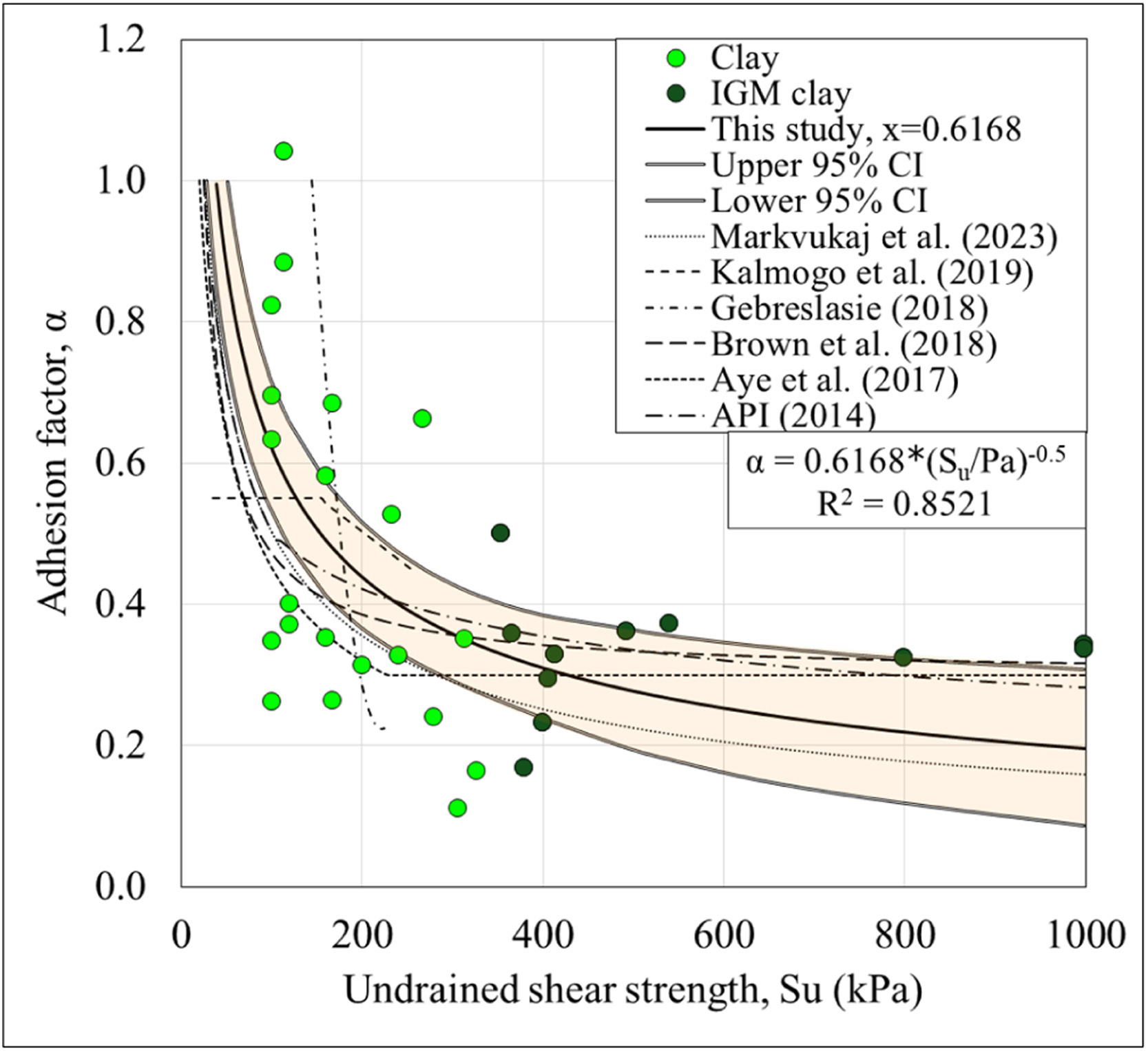
Title: Adhesion factors for clay and IGM clay
Caption: Adhesion factors generally decrease with increasing normalized undrained shear strength. IGM clay forms the upper envelope of the clay response, indicating its transitional behavior between ordinary clay and weak rock.
Credit: Professor Shinya Inazumi from Shibaura Institute of Technology, Japan
Source Link: https://doi.org/10.1016/j.rineng.2026.112199
License Type: CC BY 4.0
Usage restrictions: Credit must be given to the creator
Large-diameter bored piles are widely used to support heavy structural loads in infrastructure projects such as high-rise buildings, bridges, and ports constructed on thick soil deposits overlying weak or weathered rock formations. In these settings, a significant portion of their load-bearing capacity is provided by shaft resistance mobilized along clay and sand layers. Accurate estimation of shaft resistance is therefore essential for effective foundation design, ensuring structural safety while improving the understanding of pile–soil interaction.
Shaft resistance of bored piles is commonly estimated using empirical design approaches, such as the adhesion factor (α) method for cohesive soils and the friction factor (β) method for cohesionless soils. These methods relate shaft resistance to basic soil strength parameters. However, the values of α and β reported in the literature vary considerably due to the influence of soil type, geological conditions, construction technique, and stress history. Moreover, studies only focus on ordinary soils, overlooking the behavior of intermediate geomaterials (IGMs)—the stiff transitional soils that lie between ordinary ground and weak rock, thereby limiting the applicability of conventional design parameters to these soils.
To address this gap, a research team led by Professor Shinya Inazumi from the College of Engineering at Shibaura Institute of Technology, Japan, conducted instrumented static pile load tests to investigate shaft resistance of large-diameter bored piles embedded in clay and sand layers overlying weak rock formations. “Our study tackles one of civil engineering's most common yet uncertain problems: predicting how much load the shaft of a large bored pile can carry in layered ground,” explains Prof. Inazumi. “Drawing on 20 full-scale instrumented load tests along a 180-km infrastructure corridor, in this study, we evaluate shaft resistance layer by layer, delivering field-calibrated design correlations.” Their study was made available online on July 25, 2026, and published in Volume 32 of Results in Engineering on December 1, 2026.
The study was conducted in the northeastern region of Thailand, where a total of 158 boreholes were drilled at an average spacing of about 1.1–1.2 km per borehole, over a 180-km-long stretch. The soil profile investigation was conducted using the Standard Penetration Test. The bored piles were constructed using a wet process with bentonite slurry. A total of 20 instrumented static load tests were conducted with maximum applied loads ranging from 16.25 to 25 meganewtons, corresponding to 2.5 times the allowable working load. The piles were embedded in layered ground comprising either clay or sand overlying weak siltstone or sandstone. Static load tests were instrumented using vibrating-wire strain gauges and extensometer rods to monitor load transfer along the pile shaft.
Layer-by-layer strain-gauge measurements were used to create a dataset of unit shaft resistance. The dataset included 32 clay and IGM clay layers and 10 sand and IGM sand layers. Furthermore, representative maximum shaft resistance values were selected from fully mobilized layers, based on a mobilization criterion derived from layer-specific stress-displacement curves.
Using this dataset, the researchers back-calculated α values for the 32 clay and IGM clay layers and β values for the 10 sand and IGM sand layers, which were subsequently used to derive empirical correlations for each parameter. The calculated α values ranged from 0.11 to 1.04, decreasing with increasing normalized undrained shear strength. The empirical equation for α obtained in the study offers a practical mid-range estimate for clays overlying weak rock. Notably, comparison of α values for clay, IGM clay, and weak rock revealed a gradual transition, indicating that IGM clay behaves as an intermediate material between ordinary clay and weak rock, approaching the upper envelope of clay behavior.
The calculated β values ranged from 0.45 to 1.06 across the investigated sand layers, and the proposed empirical equation showed good agreement with existing correlations reported in the literature. Furthermore, β values obtained for IGM sand followed the same overall trend, suggesting that conventional β-method formulations can also be applied to IGM sand when stress history and site-specific ground conditions are appropriately considered.
The findings of this study offer crucial insights for the detailed design of large-diameter bored piles for use in soil-rock transition environments. Importantly, the findings demonstrate that IGMs should not be treated the same as conventional soils without considering transitional behavior. The researchers further suggest that a normalized undrained strength of approximately 10 can serve as a practical reference for identifying the transition from IGM clay to weak rock.
“The most direct application of our research lies in the design of foundations for heavy infrastructure built on thick soil deposits overlying weak or weathered rock, which are common across Southeast Asia and many other regions worldwide,” notes Prof. Inazumi. “The empirical correlations presented in this study can be readily applied by engineers to produce more reliable capacity estimates during the preliminary design stage without costly additional testing. Improved estimation of shaft resistance can enable the use of shorter piles and less concrete, reducing construction costs while supporting safer infrastructure development.”
By replacing guesswork with field-verified evidence, this study offers engineers practical tools for designing safer and more economical large-diameter bored pile foundations in complex soil-rock transition environments.
Reference
Title of original paper:
Shaft adhesion and friction factors for large-diameter bored piles in clay, sand, and intermediate geomaterials: Back-analysis from instrumented load testsJournal:
Results in EngineeringDOI:
10.1016/j.rineng.2026.112199Additional information for EurekAlert
Latest Article Publication Date: 1 December 2026Method of Research: Experimental study
Subject of Research: Not applicable
Conflicts of Interest Statement:The authors declare that they have no known competing financial interests or personal relationships that could have appeared to influence the work reported in this paper.
About Shibaura Institute of Technology (SIT), Japan
Shibaura Institute of Technology (SIT) is a private university with campuses in Tokyo and Saitama. Since the establishment of its predecessor, Tokyo Higher School of Industry and Commerce, in 1927, it has maintained “learning through practice” as its philosophy in the education of engineers. SIT was the only private science and engineering university selected for the Top Global University Project sponsored by the Ministry of Education, Culture, Sports, Science and Technology and had received support from the ministry for 10 years starting from the 2014 academic year. Its motto, “Nurturing engineers who learn from society and contribute to society,” reflects its mission of fostering scientists and engineers who can contribute to the sustainable growth of the world by exposing their over 9,500 students to culturally diverse environments, where they learn to cope, collaborate, and relate with fellow students from around the world.Website: https://www.shibaura-it.ac.jp/en/
About Professor Shinya Inazumi from SIT, Japan
Dr. Shinya Inazumi is a Professor in the College of Engineering at Shibaura Institute of Technology (SIT), Japan, and leads the Geotechnical Engineering Laboratory, where research focuses on sustainable ground and infrastructure solutions. He received his Ph.D. in Engineering from Kyoto University. His research interests span civil and geotechnical engineering, geo-disaster mitigation, and AI applications in infrastructure planning. As an established author with hundreds of publications, he has also been recognized with prestigious awards for research excellence in geotechnical and environmental engineering.Funding Information
The authors received no financial support for the research, authorship, and/or publication of this article.Media Contact: Kohei Tsuchiya
E-mail: koho@ow.shibaura-it.ac.jpWeb: https://www.shibaura-it.ac.jp/en/
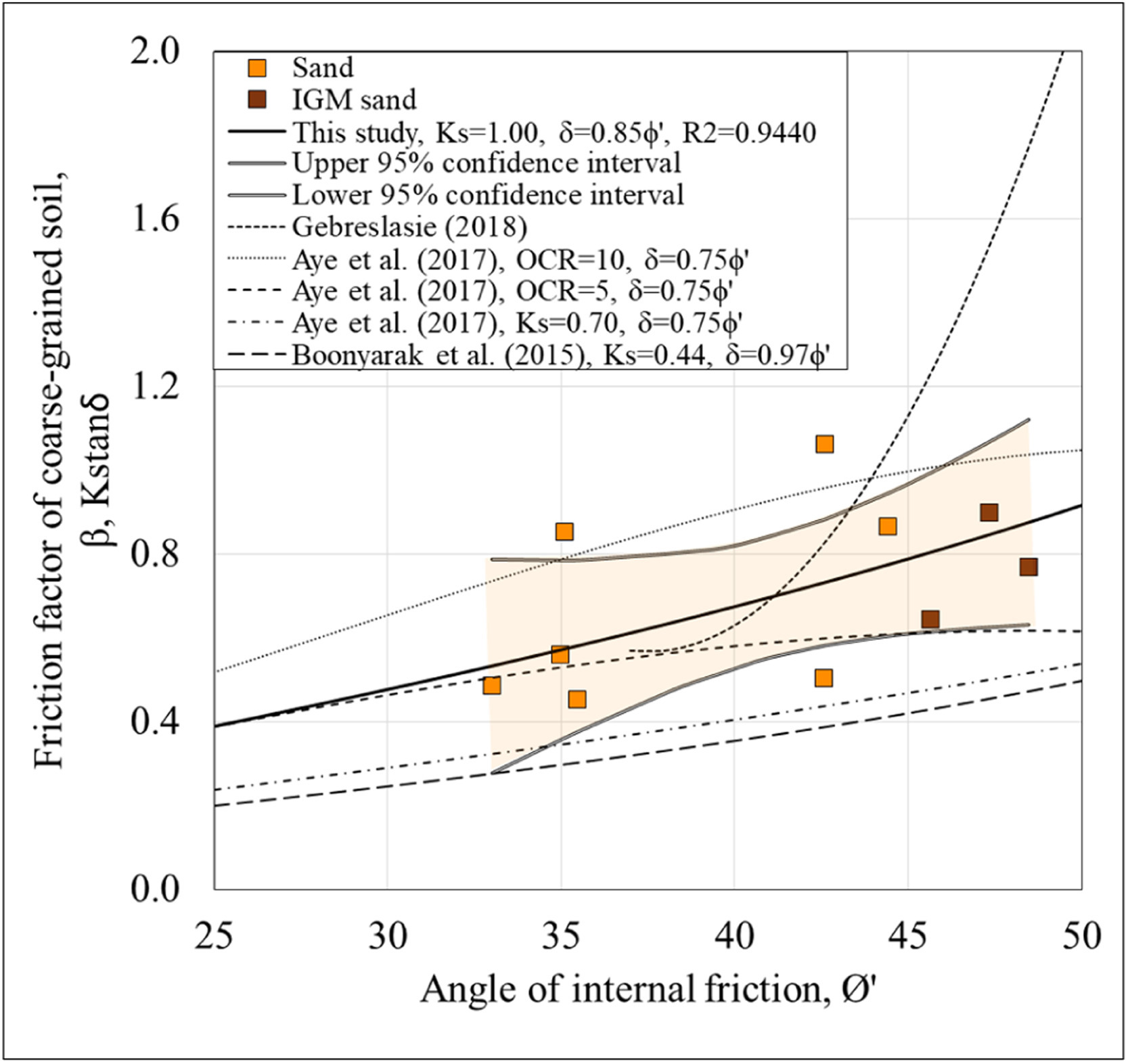
Title: Friction factors for sand and IGM sand
Caption: The friction factors for IGM sand follow the same overall trend as those for sand, indicating that conventional friction-factor formulations may also be applicable to IGM sand when stress history and site-specific ground conditions are properly considered.
Credit: Professor Shinya Inazumi from Shibaura Institute of Technology, Japan
Source Link: https://doi.org/10.1016/j.rineng.2026.112199
License Type: CC BY 4.0
Usage restrictions: Credit must be given to the creator