

Innovative Global Program (IGP)
The curriculum described on this page applies to students enrolling in Academic Year 2027 or later.
Students who enrolled in Academic Year 2026 or earlier follow a different curriculum and should see below.
Innovative Global Program (For students enrolled in AY 2026 or earlier)
Academic Guide
Innovative Global Program Overview
Program Overview
The Innovative Global Program (IGP) is an English-taught undergraduate program in the College of Engineering at Shibaura Institute of Technology.
IGP provides students with a broad foundation in mathematics, physics, chemistry, computer science, and engineering before they advance into their chosen field of specialization. Students first develop the fundamental knowledge and skills needed across engineering disciplines, and then progressively deepen their expertise through advanced specialized subjects and research.
Students can specialize in one of five broad engineering fields:
- Mechanical Engineering
- Chemistry and Materials
- Electrical and Electronic Engineering
- Computer and Communications Engineering
- Civil Engineering
The program combines strong fundamentals, specialized engineering education, interdisciplinary learning, laboratory research, and international experience. All courses and research supervision required for graduation are provided in English.
Educational Approach
IGP is designed around a gradual transition from broad engineering foundations to specialized study and research.
During the first three semesters, students build strong foundations in mathematics, science, computer science, communication, humanities, and other fundamental subjects. At the same time, IGP Core subjects introduce students to different areas of engineering and to the methods used in different fields.
From the fourth semester, students begin to focus on their chosen specialization field and take more advanced subjects related to that field.
From the fifth semester, students join a laboratory and begin graduation research. Through advanced coursework and laboratory activities, they develop the ability to apply engineering knowledge to open-ended problems, conduct research, communicate their findings, and work with researchers from different backgrounds.
This structure allows students to develop a clear area of expertise while continuing to interact with other engineering fields throughout their undergraduate education.
Curriculum Structure
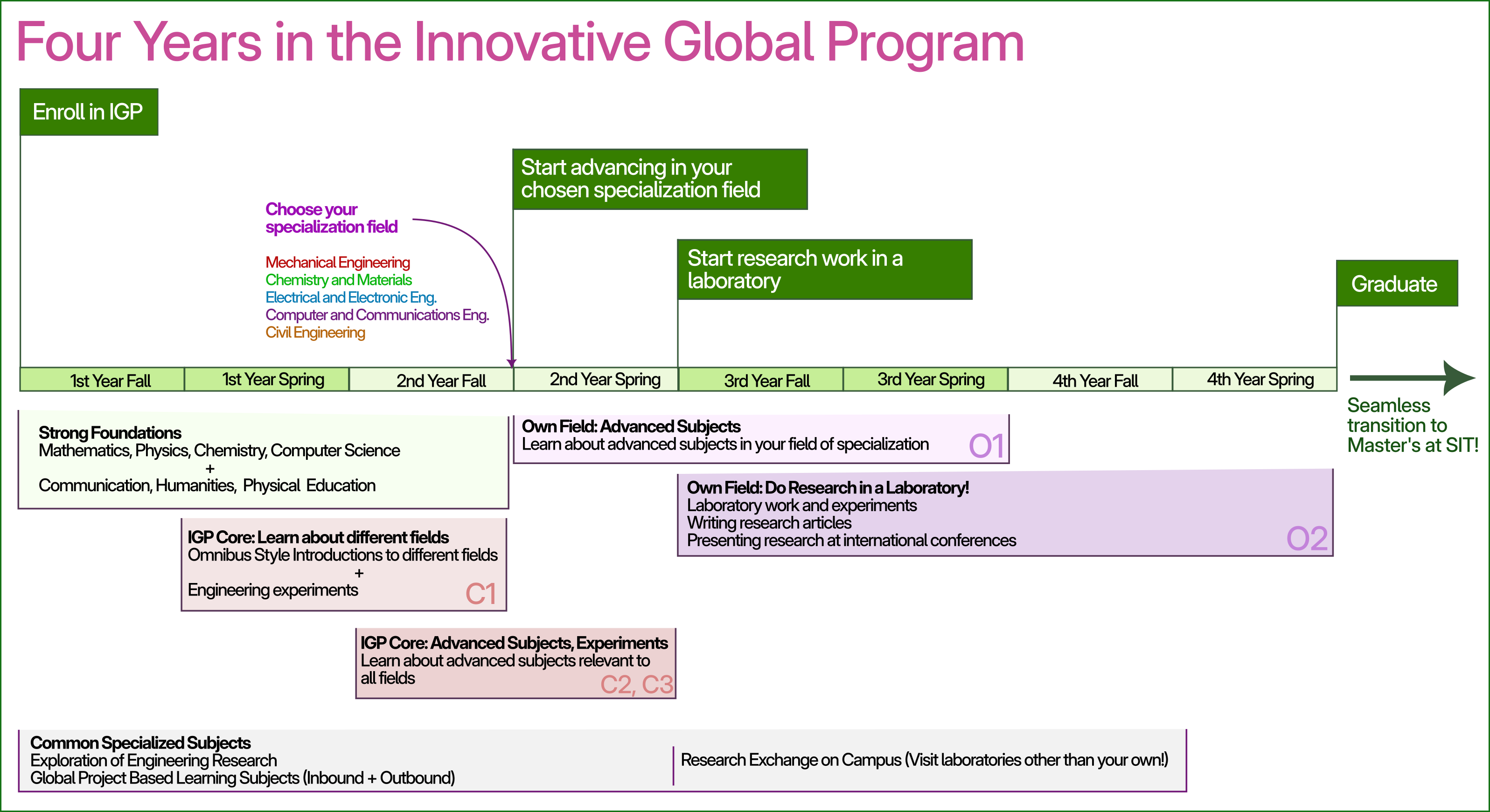
Strong Foundations: The First Three Semesters
A strong foundation in mathematics, science, and computer science is central to the IGP curriculum.
During the first three semesters, students from all specialization fields study a common set of fundamental subjects. These subjects provide the mathematical, scientific, computational, and analytical tools required for later specialized study and research.
Rather than requiring students to specialize immediately after entering university, IGP gives students time to develop their engineering foundations, encounter different fields, and identify the area they would like to pursue in greater depth.
IGP Core Subjects: C1, C2, and C3
The IGP Core consists of subjects that can be taken by students regardless of their eventual specialization field.
C1: Explore Different Engineering Fields
C1 subjects are omnibus-style introductory subjects taught by faculty members from different engineering fields.
Students are introduced to a variety of engineering topics, research questions, approaches, and methods. By learning directly from faculty working in different areas, students can discover the breadth of engineering before selecting the field in which they wish to specialize.
C1 therefore helps students connect the fundamental mathematics and sciences studied in the early curriculum with the different ways in which these foundations are applied across engineering.
C2: Build Advanced Engineering Knowledge
C2 provides students with opportunities to study advanced subjects that are open to students across IGP specialization fields.
Students can develop knowledge in areas such as advanced mathematics, numerical and computational methods, optimization, physics, chemistry, machine learning, and engineering research.
These subjects allow students to strengthen the analytical and technical tools needed for advanced study and research while also giving them opportunities to learn beyond the boundaries of their own specialization.
C3: Develop Experimental and Research Skills
C3 focuses on the practical skills required for engineering study and research.
Through comprehensive engineering experiments and preparatory research activities, students learn how to conduct experiments, analyze results, approach engineering problems systematically, and prepare for work in a research laboratory.
Together, C1, C2, and C3 provide a common academic foundation shared by IGP students across different specialization fields.
Choose Your Specialization
Students choose their specialization field during the second year.
Beginning in the fourth semester, they increasingly study subjects associated with their selected field:
- Mechanical Engineering
- Chemistry and Materials
- Electrical and Electronic Engineering
- Computer and Communications Engineering
- Civil Engineering
These specialization fields correspond closely to the major engineering areas represented throughout the College of Engineering. As a result, IGP students develop their expertise within the same broad academic environment as students in the other College of Engineering programs.
O1: Advanced Study in Your Own Field
O1 subjects are advanced specialized subjects related to each student's selected field.
After developing common mathematical, scientific, computational, and engineering foundations, students use O1 subjects to deepen the knowledge required in their own area of specialization.
This enables students to move from broad engineering education toward a well-defined area of expertise while retaining opportunities to learn from other fields.
O2: Research in a Laboratory
From the third year, students join a research laboratory and begin research related to their specialization.
O2 subjects are centered on graduation research and related research activities.
Students work closely with faculty members and other students in their laboratories, gradually developing the ability to:
- identify and formulate research problems;
- apply engineering knowledge and research methods;
- conduct experiments, simulations, analysis, or design;
- evaluate and discuss research results;
- write about their research clearly; and
- present their work to academic and professional audiences.
Students may also have opportunities to present their research at international conferences and contribute to research publications.
Laboratory research continues through the third and fourth years, allowing students to develop their expertise over an extended period rather than treating graduation research as an isolated activity at the end of their degree.
Learning Across the College of Engineering
An important feature of IGP is that specialization does not mean isolation from other engineering fields.
IGP is closely integrated with the wider College of Engineering, giving students opportunities to learn about, work with, and conduct research alongside students and faculty from other programs.
Exploration of Engineering Research
In Exploration of Engineering Research, students explore research being conducted in laboratories throughout the College of Engineering.
By watching laboratory introductions from different fields, students learn:
- what kinds of problems different laboratories investigate;
- what research methods they use;
- how their research relates to engineering and society; and
- how different fields may connect with one another.
This helps students understand the range of research available within the College of Engineering and discover possible cross-disciplinary connections to their own interests.
Global Project-Based Learning
Students can participate in Global Project-Based Learning (Global PBL) activities.
Working with students from different academic and cultural backgrounds, they address engineering and social problems through teamwork and project-based activities.
These experiences provide opportunities to apply engineering knowledge outside conventional classroom settings while developing communication, collaboration, problem-solving, and intercultural skills.
Research Exchange on Campus
Students can also participate in Research Exchange on Campus, which provides opportunities to experience research in laboratories other than their own.
By visiting and conducting research in another laboratory, students can encounter different research methods, technologies, and ways of approaching engineering problems.
This allows students to deepen their own specialization while gaining perspectives from other fields and encourages interaction among students and researchers throughout the College of Engineering.
Four Years in IGP
1st Year: Build Your Foundations
Students begin with mathematics, physics, chemistry, computer science, communication, humanities, and other fundamental subjects. Through IGP Core subjects, they are also introduced to different engineering fields and research approaches. The goal is to establish a strong academic foundation while allowing students to explore the breadth of engineering.
2nd Year: Choose and Begin Advancing in Your Field
During the first half of the second year, students continue strengthening their common engineering foundations. From the fourth semester, they begin specializing in their chosen field and take advanced subjects related to that specialization. They can also continue taking IGP Core subjects that broaden their mathematical, scientific, computational, experimental, and research skills.
3rd Year: Begin Research
From the fifth semester, students join a laboratory and begin graduation research. Advanced own-field subjects and research activities are studied in parallel, enabling students to connect theoretical knowledge with real engineering and research problems. Students can also broaden their experience through Global PBL, Research Exchange on Campus, and other College of Engineering activities.
4th Year: Advance and Communicate Your Research
Students continue and complete their graduation research, developing greater independence and expertise within their chosen field. They work toward communicating their results through a graduation thesis and research presentations and may have opportunities to present their work at academic conferences. The fourth year also prepares students for careers in engineering and technology or for continued research at graduate school.
Integration with the College of Engineering
IGP is not a separate academic environment isolated from the rest of the College of Engineering.
Its five specialization fields are closely connected to the engineering fields represented by the other programs in the College. IGP students therefore share a broader academic and research environment with students specializing in related areas across the College.
Common College of Engineering activities further strengthen these connections:
- Exploration of Engineering Research introduces students to laboratories across different programs.
- Global PBL brings students together through collaborative projects.
- Research Exchange on Campus allows students to experience research outside their own laboratory and specialization.
- Through these opportunities, students develop depth in their own field together with an understanding of how different engineering disciplines connect.
Key Features of IGP
1. Complete an Engineering Degree in English
IGP provides an environment in which students can complete their undergraduate engineering education and research supervision in English. Students study alongside classmates and faculty members from a variety of countries and academic backgrounds, creating a multicultural environment for engineering education and research.
2. Strong Foundations Before Specialization
Students spend their first three semesters developing strong foundations in mathematics, science, and computer science before moving deeply into a specialization. This ensures that advanced engineering study is supported by the analytical and scientific knowledge required across engineering disciplines.
3. Explore Before Choosing Your Field
Through omnibus-style IGP Core subjects and exposure to different research areas, students can explore a range of engineering disciplines before committing to a specialization.
4. Develop Expertise in a Selected Engineering Field
Beginning in the fourth semester, students progressively deepen their knowledge through advanced own-field subjects. This creates a clear path from common engineering foundations to specialized professional and academic knowledge.
5. Two Years of Laboratory Research
Students begin laboratory research from the third year and continue through graduation. The extended research period allows them to develop research skills, technical expertise, academic communication skills, and the ability to solve open-ended engineering problems.
6. Learn Beyond Your Own Specialization
IGP students remain connected to the wider College of Engineering through common subjects, Global PBL, Exploration of Engineering Research, and Research Exchange on Campus. These opportunities help students combine specialized expertise with a broader engineering perspective.
Degree
Students who successfully complete the program are awarded a Bachelor of Engineering.
The program is designed to provide both the specialized knowledge expected of an engineering graduate and the broad perspective needed to collaborate across disciplines and cultures.
Future Pathways
IGP graduates develop a combination of:
- specialized engineering knowledge;
- strong foundations in mathematics, science, and computing;
- analytical and technical problem-solving skills;
- research experience; interdisciplinary perspectives;
- communication and teamwork skills; and
- experience working in an international environment.
Graduates can pursue careers in engineering, technology, research, and related industries in Japan and internationally.
Students who wish to further deepen their expertise can also continue to graduate study. The substantial research experience gained during the third and fourth years provides a strong foundation for master's-level research and advanced professional work.
IGP therefore provides a pathway from engineering foundations, to specialization, to research, and ultimately to advanced study or professional engineering careers.